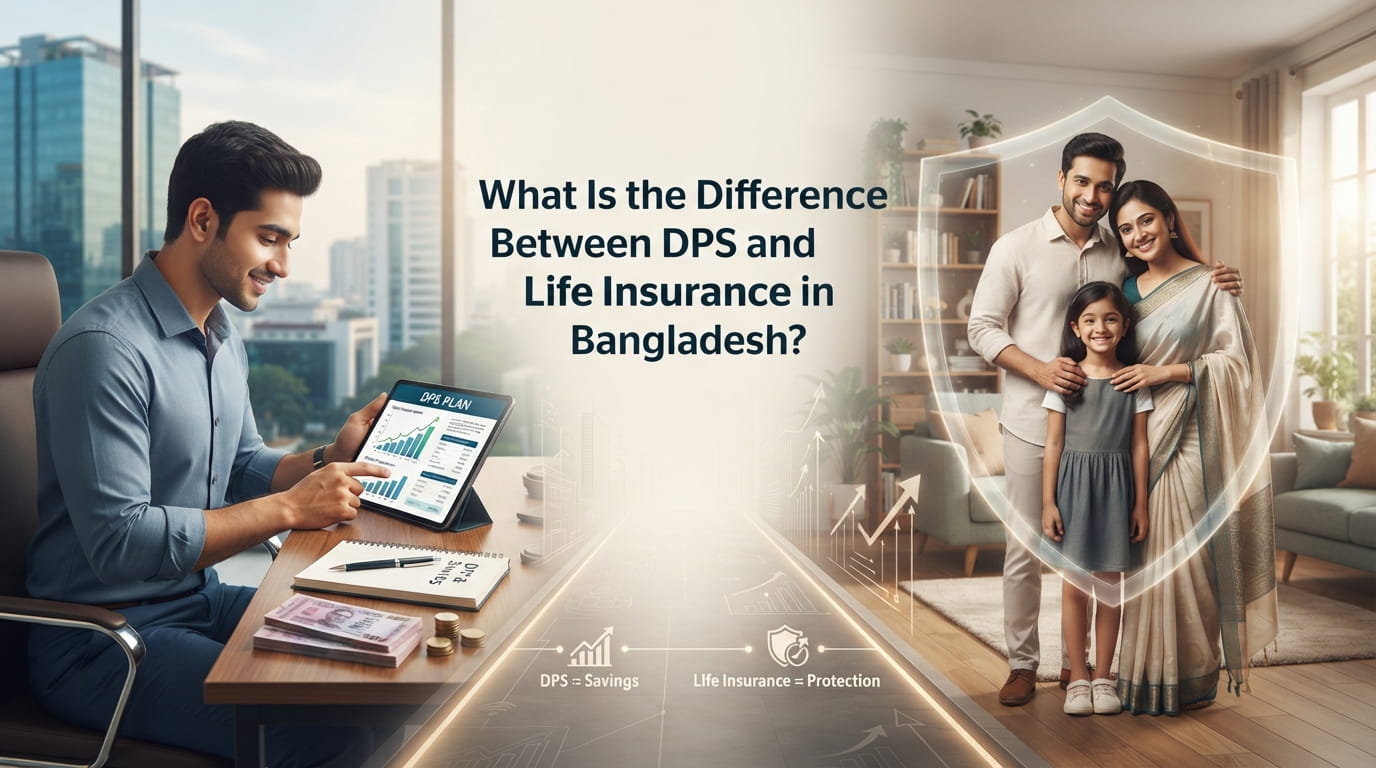
What Is the Difference Between DPS and Life Insurance in Bangladesh? Complete Comparison Guide
Imagine Rahim, a 28-year-old professional in Bangladesh. He earns Tk. 45,000 a month and wants to save regularly for his future. He is thinking about putting Tk. 5,000 every month into a DPS.
Then he starts thinking about another question: Should he choose a DPS, or should he consider life insurance instead?
This is a common question. Both can involve regular payments and long-term financial planning, but they are not designed for exactly the same purpose.
A DPS is generally a structured savings arrangement where you deposit money regularly for a defined period and receive the accumulated amount according to the scheme's terms. Bangladesh Bank classifies DPS under recurring deposits, while individual bank rules determine matters such as tenure, interest/profit, installments and premature encashment.
Life insurance, on the other hand, is primarily designed to provide financial protection against specified risks, particularly the death of the insured. Depending on the policy, it may also include maturity, savings, survival, pension or other benefits.
So, if you are searching for “What is the difference between DPS and life insurance?”, the simplest answer is this:
🔷 What Is the Difference Between DPS and Life Insurance?
DPS is primarily a structured savings product, while life insurance is primarily a financial protection product. With a DPS, you normally make regular deposits toward a future savings goal. With life insurance, you pay premiums for insurance coverage, and depending on the policy, you may also receive maturity or other benefits. Therefore, DPS and life insurance serve different financial purposes.
The important point is that DPS vs life insurance is not always an either-or decision. Your choice should depend on what you are trying to accomplish with your money.
🔷 What Is DPS in Bangladesh?
A DPS, or Deposit Pension Scheme, is generally a recurring savings arrangement. You commit to depositing a fixed amount regularly—often every month—for a selected period.
For example, you might decide to save Tk. 3,000 every month for five years. Instead of keeping the money in your everyday account and possibly spending it, a DPS creates a structured savings habit.
Bangladesh Bank's banking framework describes DPS as a recurring deposit and allows banks to configure factors such as duration, deposit amount, interest/profit rate and premature-encashment rules according to their policies.
🔷 Why do people use DPS?
A DPS can be useful when your main objective is building savings through regular deposits.
People may use a DPS for goals such as:
🔸Children's future education
🔸Marriage expenses
🔸A future business need
🔸A planned major purchase
🔸Long-term savings
🔸Building a financial reserve
🔸Retirement-oriented savings
The biggest advantage for many people is simple discipline.
You decide the amount first. Then you regularly put that money aside.
That can be much easier than telling yourself, “I will save whatever is left at the end of the month.”
🔷 How does DPS maturity work?
At the end of the selected term, the account generally reaches maturity. The amount you receive depends on the deposits made and the applicable interest/profit and terms of that particular DPS.
The exact maturity amount is not the same across all DPS products. Banks can have different installment amounts, tenures, rates and premature-encashment rules.
So before opening a DPS, check:
🔸Monthly installment
🔸Tenure
🔸Applicable interest/profit
🔸Maturity amount
🔸Early withdrawal rules
🔸Missed-installment rules
🔸Applicable taxes and charges
🔸Nominee arrangements
🔷 What Is Life Insurance?
Life insurance is designed around a different idea: financial protection.
You pay a premium according to the policy terms, and the insurer provides coverage based on the policy. If the insured event covered by the policy occurs, the eligible benefit may be paid according to the policy's terms and conditions.
For a life insurance policy, important terms often include:
🔸Policyholder: The person who owns the policy.
🔸Life assured/insured: The person whose life is covered.
🔸Premium: The amount paid for the policy.
🔸Nominee: The person or persons designated to receive applicable benefits, subject to the policy and applicable rules.
🔸Policy term: The period for which the policy operates.
🔸Death benefit: The benefit payable when the insured dies during the applicable coverage period, subject to policy terms.
🔸Maturity benefit: A benefit that may be payable when an eligible policy reaches maturity.
Not every life insurance policy works in the same way.
Some are primarily protection-focused. Others combine protection with savings or maturity benefits.
National Life Insurance PLC's current product categories include Child Insurance, Pension Policy, Savings Policy, DPS, Whole Life, Survival Benefit, Islami Takaful, FDR and Group Insurance. Its published product information also includes endowment, anticipated endowment, pension, whole life, monthly savings, children's education, family savings and income, Takaful and group insurance products.
That variety is important because saying “life insurance” does not describe only one type of financial product.
🔷 What Is the Difference Between DPS and Life Insurance?
Here is the key difference: DPS mainly helps you accumulate savings, while life insurance can help protect your family's finances if a covered event occurs.
But there are several important differences to understand.
1. Main Purpose: Savings vs Financial Protection
🔸DPS:
The primary objective is disciplined saving. You regularly deposit money and build a future amount.
🔸Life Insurance:
The primary objective is financial protection. The policy is designed to provide specified benefits when covered events occur. Depending on the product, it may also provide savings or maturity benefits.
Think of it this way:
🔸DPS asks:
“How can I regularly save money for a future goal?”
🔸Life insurance asks:
“How can I protect my family's financial future if something happens to me?”
These are different questions.
2. How You Put Money In
With a typical DPS, you make regular deposits according to the scheme.
For example:
🔸DPS:
Tk. 3,000 per month × selected tenure.
With life insurance, you generally pay premiums according to the policy's payment schedule.
🔸Life Insurance:
Premium payment × policy term × applicable policy benefits.
The amount you pay does not tell you everything about the value of the product. With insurance, you are also paying for the protection and benefits provided under the policy.
That is why comparing only “How much money did I pay?” can give you an incomplete picture.
3. Does DPS Provide Life Insurance Coverage?
A normal bank DPS is primarily a savings deposit and should not be treated as a substitute for life insurance coverage.
A DPS can have a nominee arrangement, but that does not automatically mean it provides the same type of life insurance protection as an insurance policy.
The exact rights of a nominee and what happens after the account holder's death depend on the relevant account and legal terms.
If your main concern is family financial protection, you should specifically examine the insurance coverage rather than assuming that a savings account provides equivalent protection.
4. Does Life Insurance Provide Savings Benefits?
Some life insurance policies can provide savings or maturity benefits, but not every policy is designed this way.
For example, endowment and savings-oriented insurance products can combine insurance protection with a maturity benefit, subject to their terms.
National Life Insurance PLC lists several products with savings-oriented features, including endowment insurance, anticipated endowment insurance, monthly savings insurance and family savings and income insurance.
This is where many people get confused.
A savings-oriented life insurance policy is still insurance. Its benefits, premiums, maturity conditions and protection features must be understood from the actual policy document.
5. What Happens If the Account Holder or Policyholder Dies?
This is one of the biggest differences between DPS and life insurance.
🔸 DPS:
A DPS account may have a nominee. If the account holder dies, the money is dealt with according to the bank's account terms and applicable legal procedures.
The key point is that a normal DPS is not primarily designed to replace the account holder's future income through life insurance coverage.
🔸 Life Insurance:
A life insurance policy is specifically designed around insured risk. If the policyholder/insured dies under circumstances covered by the policy, an eligible death benefit may be payable according to the policy terms.
For a family dependent on one person's income, this distinction can be extremely important.
🔷 What Is the Difference Between DPS Maturity and Life Insurance Maturity?
DPS maturity generally means receiving the accumulated deposit amount plus applicable interest/profit according to the scheme's terms. Life insurance maturity refers to a benefit payable under an eligible insurance policy when the policy reaches its maturity date, according to its specific terms.
A DPS maturity is therefore mainly connected to your savings arrangement.
A life insurance maturity can be connected to both the policy's insurance structure and its applicable savings or maturity benefits.
Some life insurance policies may also provide bonuses or other benefits where applicable. These should never be assumed without checking the specific product terms.
6. Long-Term Financial Planning
Both DPS and life insurance can have a place in long-term financial planning, but they can solve different problems.
Suppose your goal is:
“I want to accumulate money for my child's education after 10 years.”
A structured savings product may be relevant.
But suppose your goal is:
“If I die unexpectedly, I want my family to have financial protection.”
That is an insurance need.
And sometimes you have both goals.
You may want to build savings while also making sure your dependents have financial protection.
That is why a complete financial plan should look at the whole picture—not just one product.
7. Access to Money
Liquidity is another important consideration.
With DPS, early withdrawal or premature encashment may be possible depending on the bank and product, but the amount received and applicable conditions can differ. Bangladesh Bank's framework specifically allows banks to configure premature-encashment rules according to their policies.
Life insurance can also have surrender, loan, withdrawal or other options in some products, but these are policy-specific.
Therefore, do not assume:
🔸Every DPS can be withdrawn freely.
🔸Every life insurance policy can be cancelled without financial consequences.
🔸Every policy has a loan facility.
🔸Every product provides the same surrender value.
Always read the applicable terms before committing your money.
8. Returns and Benefits
One of the most common mistakes in a DPS vs life insurance comparison is focusing only on returns.
A DPS is usually evaluated around:
🔸Deposit amount
🔸Interest/profit
🔸Tenure
🔸Maturity value
🔸Applicable deductions
🔸Withdrawal conditions
Life insurance may involve:
🔸Premium
🔸Insurance coverage
🔸Death benefit
🔸Maturity benefit, where applicable
🔸Survival benefits, where applicable
🔸Bonuses, where applicable
🔸Surrender value, where applicable
🔸Other policy-specific benefits
These are not directly comparable numbers.
If someone asks, “Which gives the higher return?” the honest answer is:
You need to compare specific products and their terms.
A life insurance policy should not be judged like a pure deposit account because part of its value comes from financial protection.
Example 1: A Young Professional Choosing DPS
Suppose Arif is 27 and earns Tk. 40,000 per month.
He has no dependents yet. His main goal is to build money for a future business and create a regular savings habit.
He decides that saving Tk. 4,000 every month is affordable.
For Arif, a DPS may be worth considering because his immediate priority is disciplined accumulation of savings.
But he should still check the actual DPS terms, maturity amount, applicable rate, taxes, charges and early-encashment rules before opening the account.
What can we learn from this?
The right financial product starts with the goal.
Arif is primarily asking:
“How can I save regularly?”
That makes a structured savings product relevant to his situation.
Example 2: A Married Person With Dependents
Now consider Hasan, age 35.
He earns Tk. 60,000 per month and supports his spouse and two children. He wants to save Tk. 5,000 every month for his children's future.
But he has another concern:
“What happens to my family if I am no longer there to earn?”
This changes the financial conversation.
Hasan does not only have a savings goal. He also has a family financial protection need.
A life insurance policy may therefore deserve serious consideration, depending on the coverage, premium affordability, policy term and benefits.
He could also consider whether maintaining separate savings alongside appropriate insurance protection makes sense for his overall financial plan.
What can we learn from this?
A person's financial responsibilities matter.
The question is not simply:
“Which gives me more money?”
It is:
“What financial risks and goals do I need to plan for?”
🔷 DPS or Life Insurance: Which One May Be Right for You?
There is no universal winner.
The better question is: What are you trying to achieve?
DPS may be worth considering if:
🔸Your main goal is disciplined savings.
🔸You want to save a fixed amount regularly.
🔸You have a specific future financial target.
🔸You are comfortable with the DPS's tenure.
You understand the maturity and premature-encashment conditions.
You primarily want to accumulate savings.
Life insurance may be worth considering if:
🔸You have dependents.
🔸Your family depends on your income.
🔸Financial protection is important to you.
🔸You want insurance coverage alongside applicable policy benefits.
🔸You are planning for long-term family financial security.
🔸You want to explore savings-oriented insurance, pension or other life insurance solutions.
These are general educational considerations—not personalized financial advice.
🔷 Is DPS Better Than Life Insurance?
Not necessarily. DPS and life insurance are designed for different financial purposes. A DPS may be more relevant when your main priority is disciplined savings, while life insurance may be more relevant when protecting dependents from financial loss is a major concern. The right choice depends on your goals, affordability, time horizon and need for protection.
🔷Is Life Insurance Better Than DPS?
Life insurance is not automatically better than DPS. If your only immediate goal is building regular savings for a defined target, a DPS may fit that purpose. If you need financial protection for your family, life insurance may address a need that a normal DPS does not. Compare the products based on their actual purpose and terms.
🔷 Can I Have Both DPS and Life Insurance?
Yes, a person may consider having both as part of a broader financial plan, depending on affordability and financial goals. DPS can support disciplined savings, while life insurance can address financial protection needs. Before using both, make sure your total monthly commitments are affordable and that you maintain an appropriate emergency reserve.
This can be a useful way to think about financial planning:
Savings + Protection = A more complete financial strategy
But the exact combination should depend on your personal circumstances.
🔷 What Should You Consider Before Choosing DPS?
Before opening a DPS, ask yourself:
🔸How much can I comfortably save every month?
🔸What is my financial goal?
🔸How long can I keep the money committed?
🔸What is the maturity amount?
🔸What interest/profit applies?
🔸What happens if I miss an installment?
🔸What happens if I withdraw early?
🔸What taxes or charges may apply?
🔸Who is the nominee?
🔸Do I also need separate life insurance protection?
Never choose a DPS simply because someone tells you that the maturity amount looks attractive.
Read the terms.
🔷 What Should You Consider Before Buying Life Insurance?
Before buying a life insurance policy, look beyond the premium.
Consider:
🔸Who depends on your income?
🔸How much financial protection does your family need?
🔸What is the policy term?
🔸What is the sum assured?
🔸What are the premium payment requirements?
🔸What happens if you miss a premium?
🔸What is covered?
🔸What exclusions apply?
🔸What is the death benefit?
🔸Is there a maturity benefit?
🔸Are there survival benefits?
🔸Is there a surrender or loan facility?
🔸What are the applicable policy conditions?
🔸Who will receive the benefit?
Most importantly, read the policy document before making a commitment.
🔷 Is Life Insurance Useful for Salaried People in Bangladesh?
Yes, life insurance can be relevant for salaried people, particularly when family members depend on their income. A salary provides regular cash flow, but that income can stop if the earning person dies. Life insurance can help address this financial risk through benefits provided under the policy. The appropriate coverage depends on income, dependents, affordability and policy terms.
For a young employee with no dependents, the priority may be different.
For a married employee supporting parents, a spouse or children, the need for financial protection may become more significant.
This is why age alone should not determine your decision.
🔷 How National Life Insurance PLC Can Fit Into the Conversation
Once you understand the difference between savings and protection, the next step is to explore the types of life insurance solutions available for different financial goals.
National Life Insurance PLC offers a range of insurance categories, including savings, pension, whole life, child insurance, survival benefit, Islamic Takaful and group insurance. Its published product portfolio also includes endowment, anticipated endowment, monthly savings, family savings and income, pension and children's education-related solutions.
This range is useful because financial needs are different.
A parent may want to explore a child-focused solution.
Someone approaching retirement may be more interested in pension-oriented planning.
Another person may be looking for savings combined with life protection.
For readers comparing options, the sensible approach is to start with the goal and then examine the product.
You can explore National Life Insurance PLC's current product categories here: National Life Insurance PLC Products
Before purchasing any policy, review the premium, coverage, term, maturity benefits, exclusions, surrender conditions, applicable bonuses and all other policy terms carefully.
🔷 DPS vs Life Insurance: The Most Important Difference
DPS and life insurance should not be compared only by how much money you pay or receive at the end. Their primary purposes are different. A DPS is mainly a savings mechanism, while life insurance is designed to provide financial protection against covered risks. Some life insurance policies also combine protection with maturity, survival, or savings-related benefits.
This distinction is important because a person can have a large savings balance and still have insufficient financial protection for their family.
Think About It This Way
DPS helps answer:
“How can I build a fund by saving regularly?”
Life insurance helps answer:
“How can I protect my family financially if something happens to me?”
A broader financial plan may ask both questions.
🔷 DPS vs Life Insurance: What Are You Actually Paying For?
One of the easiest ways to understand the difference between DPS and life insurance is to look at what your regular payment is designed to accomplish.
With a DPS, your regular deposit is primarily building your savings balance.
With life insurance, your premium is connected to the insurance coverage and benefits provided under the policy. Depending on the product, the policy may also include maturity, survival, pension, or other benefits.
So, comparing the two simply by saying, “I paid Tk. 5,000 per month in both,” does not give you a complete comparison.
The same monthly payment can serve a different financial purpose.
🔷 Does Life Insurance Give You Something a DPS Cannot?
Potentially, yes: financial protection against specified insured risks.
A DPS primarily helps you accumulate money. Life insurance can provide an eligible death benefit under the policy if the insured event occurs and the policy requirements are satisfied.
For a person with dependents, this distinction can be significant.
Imagine someone saves Tk. 5,000 every month but dies unexpectedly after only a short period. The family may receive the applicable savings balance according to the DPS terms, but that is not automatically the same as receiving a life insurance death benefit.
With an appropriate life insurance policy, the family may have access to an eligible death benefit according to the policy terms.
That is why savings and protection should not be treated as identical financial needs.
🔷 Can a DPS Replace Life Insurance?
Generally, no. A DPS should not be treated as a substitute for life insurance because its primary purpose is savings rather than insurance protection.
A DPS can help you build financial assets over time, but it does not automatically provide the same insurance coverage as a life insurance policy.
If you have a spouse, children, parents, or other dependents who rely on your income, ask two separate questions:
🔸How much should I save?
🔸How much financial protection does my family need?
The answer to the first question may involve a savings product. The second may require insurance.
🔷 Can Life Insurance Replace a DPS?
Not necessarily. Life insurance and DPS can have different roles in a financial plan.
If your specific goal is to build a regular savings fund for a known future expense, a DPS may be relevant.
If your priority is protecting your family from the financial consequences of your death, life insurance may be relevant.
Some insurance products also include savings or maturity benefits, but that does not mean every life insurance policy works like a DPS.
Always compare the actual product terms rather than comparing the product names.
🔷 What Happens If You Stop Paying?
This is an important question that many first-time buyers forget to ask.
For DPS
The consequences of missing or stopping installments depend on the bank's specific DPS rules. There may be conditions involving missed installments, account continuation, penalties, or premature closure.
🔸 For Life Insurance
The consequences of missing premiums depend on the specific policy. Depending on the policy and how long it has been active, options or consequences may include a grace period, policy lapse, reduced benefits, revival opportunities, or other provisions.
Never assume that stopping payments works the same way for every DPS or insurance policy.
Before committing, ask the provider:
“What happens if I cannot continue my monthly payment for several months?”
That one question can prevent unpleasant surprises later.
🔷 Which Is More Flexible: DPS or Life Insurance?
Neither should automatically be called “more flexible.” Flexibility depends on the specific product terms.
A DPS may have rules for premature withdrawal, while an insurance policy may have surrender, loan, revival, or other provisions depending on the product.
Before choosing either option, check:
🔸When can I access my money?
🔸What happens if I withdraw early?
🔸What happens if I stop paying?
🔸Are there penalties or reductions?
🔸Is there a surrender value?
🔸Is there a loan facility?
🔸How does the nominee process work?
Liquidity should be part of the comparison—not an afterthought.
🔷 DPS or Life Insurance for a Child's Future?
The answer depends on whether your priority is only saving for the child or also protecting the family's ability to meet that goal if the earning parent dies.
For example, parents may want to build money for:
🔸School and university education
🔸Future marriage expenses
🔸A first home
🔸Starting a career or business
A DPS can help parents develop a regular savings habit for such goals.
A suitable child-focused or family-oriented life insurance product may address a broader need by combining applicable protection and financial benefits.
The important question is:
“If I am no longer able to provide financially, how will this goal continue?”
That question moves the conversation from simple savings to financial protection.
🔷 DPS or Life Insurance for Retirement Planning?
Both can potentially play a role in long-term financial planning, but they address different needs.
A DPS can help someone accumulate savings through regular deposits.
A pension-oriented life insurance solution may combine long-term financial planning with insurance-related benefits, depending on the product.
When planning for retirement, consider more than the final amount.
Think about:
🔸How much you need each month after retirement
🔸How long you have before retirement
🔸Whether your income can support the contribution
🔸What happens if you die before the goal
🔸Whether your spouse or family needs financial protection
🔸How easily you can access the money
🔸What benefits the specific product actually provides
Retirement planning is about income security, not simply accumulating a lump sum.
🔷 7 Questions to Ask Before Choosing DPS or Life Insurance
Before making a decision, ask yourself:
1. What is my primary goal?
Is it savings, family protection, retirement, children's education, or a combination?
2. Who depends on my income?
If nobody depends on you financially, your priorities may be different from someone supporting a spouse, children, or parents.
3. How much can I comfortably pay every month?
A financial commitment should fit your budget without putting unnecessary pressure on your everyday expenses.
4. How long can I keep the money committed?
Consider your expected financial needs before choosing a long-term product.
5. What happens if I stop paying?
Understand the consequences before signing up.
6. What happens if I die?
This is especially important when comparing a savings product with life insurance.
7. What exactly will my family receive?
Do not rely only on verbal explanations. Check the applicable account or policy documents.
🔷Common Misconceptions About DPS and Life Insurance
“DPS and life insurance are basically the same.”
False. Both can involve regular payments, but DPS is primarily a savings arrangement while life insurance is primarily designed around financial protection.
“If I have a lot of savings, I don't need life insurance.”
Not always. Savings and insurance solve different problems. A person's savings may not necessarily be enough to replace future income or meet family obligations after an unexpected death.
“Life insurance is only for older people.”
False. Life insurance can be relevant to younger adults too, particularly when they have financial dependents or long-term protection needs.
“The policy with the biggest maturity amount is automatically the best.”
Not necessarily. A proper comparison should also consider coverage, premium affordability, policy term, exclusions, surrender conditions, death benefit, maturity conditions, and other applicable terms.
“I should choose whichever gives the highest return.”
Not necessarily. Life insurance should not be evaluated solely as an investment. The value of insurance also comes from the financial protection provided under the policy.
🔷 When Should You Consider DPS and Life Insurance Together?
You may consider both when you have separate savings and protection goals and can comfortably afford both commitments.
For example:
A salaried person may use a DPS to build savings for a future goal while maintaining life insurance to protect dependents.
The logic is simple:
DPS → build savings
Life insurance → protect against financial risk
This approach can make sense for some people, but it is not a universal formula. Your income, expenses, existing savings, debts, dependents, and financial goals should determine whether using both is appropriate.
🔷 A Simple Decision Tree: DPS or Life Insurance?
If your answer is:
“I mainly want to save a fixed amount every month.”
→ Explore DPS and compare its terms carefully.
“My family depends on my income.”
→ Consider whether you need life insurance protection.
“I want savings and family protection.”
→ Compare life insurance products that include applicable savings/maturity benefits and consider whether separate savings are also appropriate.
“I want retirement income planning.”
→ Explore savings and pension-oriented options and compare their actual benefits and conditions.
“I need access to the money very soon.”
→ Carefully examine liquidity and early-withdrawal conditions before choosing a long-term commitment.
🔷 What Is the Best Way to Compare DPS and Life Insurance?
The best comparison is based on purpose, total financial commitment, protection, maturity benefits, liquidity, and policy or account terms—not just the final amount received.
Use this checklist:
🔸Purpose: What financial problem does it solve?
🔸Payment: How much do you need to pay regularly?
🔸Term: How long is the commitment?
🔸Protection: Is there insurance coverage?
🔸Death benefit: What happens if the insured dies?
🔸Maturity: What happens when the term ends?
🔸Liquidity: Can you access the money early?
🔸Early exit: What happens if you stop?
🔸Nominee: What happens after death?
🔸Affordability: Can you maintain the commitment?
🔸Terms: What exclusions, conditions, charges, or restrictions apply?
This is a much more meaningful DPS and life insurance comparison than simply asking which one has the higher return.
🔷 Frequently Asked Questions About DPS and Life Insurance
1. What is the difference between DPS and life insurance?
DPS is primarily a structured savings arrangement where you make regular deposits for a selected period. Life insurance is primarily designed to provide financial protection against specified risks, especially death, and some policies may also offer savings or maturity benefits. Therefore, DPS focuses mainly on accumulation, while life insurance combines protection with any additional policy benefits.
2. Are DPS and life insurance the same?
No. A DPS is generally a recurring deposit savings product, while life insurance is an insurance contract designed to provide specified protection and benefits. Some life insurance policies also have savings features, which can make them look similar to DPS, but their underlying purposes and terms are different.
3. Does DPS provide life insurance coverage?
A normal DPS should not be treated as equivalent to life insurance coverage. DPS is primarily designed for recurring savings. If you need financial protection for dependents after your death, you should separately examine an appropriate life insurance policy and its coverage terms.
4. Does life insurance provide savings benefits?
Some life insurance policies do provide savings or maturity benefits. Endowment and other savings-oriented policies may combine financial protection with benefits payable at maturity or under other specified conditions. The exact benefit depends on the individual policy's terms.
5. Which is better for long-term savings, DPS or life insurance?
It depends on your objective. If your main goal is disciplined recurring savings, DPS may be relevant. If you want long-term savings together with insurance protection, a savings-oriented life insurance policy may be worth exploring. Compare actual products rather than assuming one category is always better.
6. Which provides financial protection for a family?
Life insurance is specifically designed to provide financial protection under the coverage terms of the policy. A DPS is primarily a savings arrangement. For a family that depends heavily on one person's income, the protection component of life insurance can therefore be an important part of financial planning.
7. What happens to DPS if the account holder dies?
The account is generally dealt with according to the bank's account terms, nominee arrangements and applicable legal procedures. The balance in a DPS should not automatically be assumed to become an insurance payout. Check the specific bank's terms and nominee requirements.
8. What happens to life insurance if the policyholder dies?
If the insured dies during the applicable coverage period and the claim satisfies the policy requirements, the eligible death benefit may be paid according to the policy terms. The amount and conditions depend on the specific policy.
9. What is the difference between DPS maturity and life insurance maturity?
DPS maturity generally relates to receiving the accumulated deposits and applicable interest/profit under the deposit scheme. Life insurance maturity relates to a benefit payable under the insurance policy when it reaches its maturity conditions. The amount and structure depend on the specific product.
10. Should I choose DPS or life insurance?
Start with your financial goal. Choose a savings-focused product when disciplined accumulation is your main priority. Consider life insurance when family financial protection is also important. Your income, dependents, affordability, time horizon and liquidity needs should all be considered.
11. Can I have both DPS and life insurance?
Yes, depending on your financial situation. Some people may use DPS for regular savings while maintaining life insurance for family protection. The key is making sure the combined monthly commitments remain affordable and fit into a broader financial plan.
12. Is life insurance useful for salaried people in Bangladesh?
It can be particularly useful for salaried people who have dependents. If a family's regular expenses depend on one person's salary, life insurance may help provide financial protection under the policy terms if that person dies. The appropriate policy depends on the individual's circumstances.
13. What should I consider before choosing DPS?
Consider the monthly installment, tenure, applicable interest/profit, maturity amount, early-encashment conditions, missed-installment rules, taxes, charges and nominee arrangements. Most importantly, make sure the monthly installment is comfortably affordable.
14. What should I consider before buying life insurance?
Look at the coverage amount, premium, policy term, death benefit, maturity or survival benefits where applicable, exclusions, premium-payment conditions, surrender rules and other policy terms. Never choose a policy based only on the maturity amount or a sales illustration.
15. What is the difference between savings and financial protection?
Savings help you build money for future needs; financial protection helps reduce the financial impact of specified risks. DPS is generally more focused on savings, while life insurance is primarily focused on protection and may include savings-related benefits depending on the policy.
🔷 Conclusion: DPS or Life Insurance?
So, what is the difference between DPS and life insurance?
The simplest answer is:
DPS is primarily about disciplined savings. Life insurance is primarily about financial protection, although some insurance products also provide savings, maturity or survival benefits.
A DPS can be useful when your main goal is to save a fixed amount regularly for a future financial target.
Life insurance may be more relevant when you have dependents and want to protect your family's financial future against the risk of losing your income.
And you do not always have to think of them as competing products.
For some people, DPS and life insurance may serve two different parts of the same financial plan—one focused on savings and the other on protection.
Before making a decision, look at your income, monthly budget, financial goals, dependents, time horizon and need for liquidity. Then compare the actual product terms carefully.
If you are looking beyond regular savings and want to understand how life insurance may support your family's financial protection, explore the life insurance solutions available from National Life Insurance PLC and review the applicable policy terms carefully before making a decision.
The right financial decision is not necessarily the product with the biggest promised number. It is the one that fits the financial goal you are actually trying to achieve.
← Back to Insights
NLI Archive / 2026
Trending Analysis
What Is the Difference Between DPS and Life Insurance in Bangladesh?
N
NLI Editorial
© National Life Insurance Co. Ltd.
Share:
FB
LN