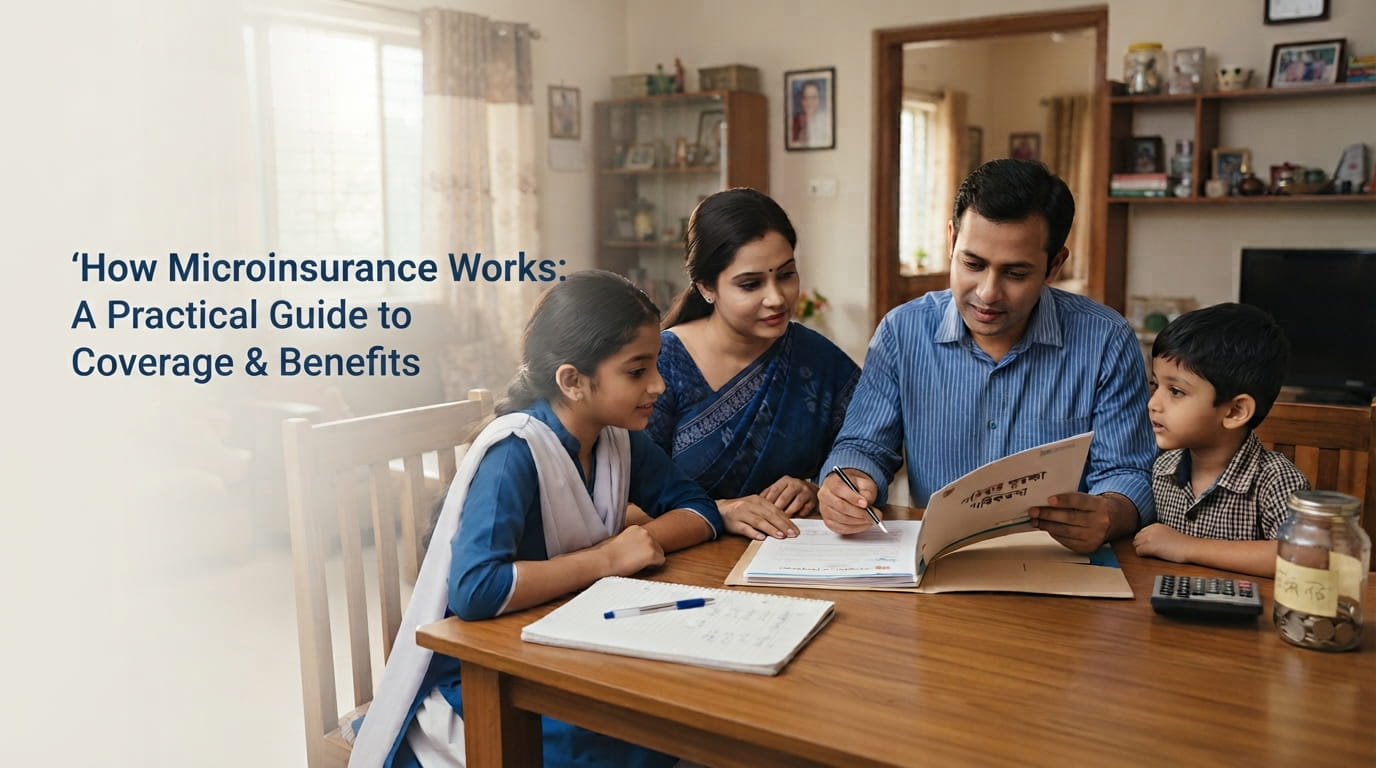
What Is Microinsurance? A Simple Guide to Coverage, Benefits & How It Works
Imagine a family in Rajshahi managing a household budget month by month. Income may be modest, but the responsibilities are not. There is food to buy, rent or housing expenses to manage, children's education to plan for, transportation costs, medical needs and sometimes financial support for parents.
Now imagine that family wants some form of financial protection but worries that insurance may be complicated, expensive or difficult to understand.
This is where the idea of microinsurance becomes relevant.
So, what is microinsurance? In simple terms, microinsurance is insurance designed to make certain forms of financial protection more accessible to people who may have limited financial resources. Depending on the specific policy, it can provide defined benefits against risks such as death, accidents or other covered events, usually with coverage and payment arrangements designed around the needs of the target customer.
But microinsurance is more than simply “cheap insurance.” Understanding how it works, what it covers and what its limitations are can help you decide whether this type of protection is appropriate for your circumstances.
What Is Microinsurance?
Microinsurance is a form of insurance designed to provide relatively accessible financial protection to people who may have limited income or fewer financial resources. Depending on the product, a policyholder pays a premium in exchange for specified coverage or benefits. The exact premium, coverage, eligibility and policy conditions depend on the individual insurance product.
Think about it this way: traditional insurance can sometimes feel like a large financial commitment when someone is just starting to think about protection. Microinsurance focuses on making insurance concepts and protection more accessible to people whose financial capacity, coverage requirements or circumstances may be different.
The word “micro” generally relates to the scale and accessibility of the insurance arrangement. It does not mean that the protection has no value or that every microinsurance policy is identical.
🔷 Microinsurance meaning in simple language
The easiest way to understand the microinsurance meaning is:
It is insurance designed around the financial realities and protection needs of people who may otherwise find conventional insurance difficult to access or maintain.
That can include people with modest incomes, informal-sector workers, small business owners, first-time insurance buyers and families looking for a manageable level of financial protection.
However, the label alone does not tell you exactly what a policy provides. The policy document remains the most important source for understanding coverage, exclusions, premiums, benefits and other conditions.
🔷 How Does Microinsurance Work?
Microinsurance works on the same basic insurance principle: a policyholder pays a premium, and the insurer provides specified financial benefits if a covered event occurs, subject to the policy's terms and conditions.
Although the exact process varies by product, a simple example looks like this:
🔸 The customer chooses a suitable insurance option.
The choice should be based on financial circumstances, protection needs, eligibility and policy terms.
🔸 A premium is paid.
A premium is the amount the policyholder pays to maintain the insurance coverage. Payment frequency may vary depending on the policy.
🔸 Coverage remains subject to the policy conditions.
The policy will explain what events are covered, for how long and under what conditions.
🔸 A covered event occurs.
If an event covered by the policy takes place, the policyholder or nominee may be able to make a claim according to the applicable requirements.
🔸 The claim is reviewed.
The insurer assesses the claim against the policy terms and required documentation.
The applicable benefit is paid if the claim meets the policy requirements.
This is why understanding the policy before purchasing matters.
Insurance should never be viewed simply as “I pay money, so everything is covered.” Coverage always depends on the specific agreement.
🔷 Important terms to understand
🔸Premium: The amount paid for insurance coverage.
🔸 Coverage: The risks, events or benefits included under a particular policy.
🔸 Policy term: The period for which the policy is designed to remain in force, subject to its conditions.
🔸 Nominee: The person designated under the policy to receive applicable benefits according to the policy terms and applicable requirements.
🔸Claim: A formal request for a policy benefit following a covered event.
🔸 Exclusion: A situation or event that the policy does not cover.
Knowing these basic terms can make insurance much less intimidating for a first-time buyer.
🔷 Why Does Microinsurance Exist?
Microinsurance exists to help make insurance protection more accessible to people whose income, financial capacity or protection requirements may not fit easily into conventional insurance arrangements.
For a family managing expenses carefully, financial risk can feel very different from what it looks like on paper.
Suppose a small shop owner in Chattogram earns a different amount from one month to another. One month may be strong; another may be difficult. The family still has groceries, school expenses, rent, utilities and other responsibilities.
The owner may understand the importance of financial protection but hesitate because insurance feels complicated.
An accessible insurance solution can make the conversation easier: What risk are you trying to protect against? What amount can you reasonably afford? How long do you need the protection? What does the policy actually cover?
Those are much more useful questions than simply asking whether an insurance policy is “cheap.”
🔷 What Does Microinsurance Cover?
Microinsurance coverage varies by product and policy. Depending on the specific insurance arrangement, it may provide defined benefits related to life protection, accidents, health-related needs or other specified risks.
It is important not to assume that every microinsurance policy provides all of these benefits.
Possible areas of coverage can include:
🔸 Life protection
Some insurance arrangements may provide a benefit following the death of the insured person, subject to the applicable policy terms.
For a family dependent on one primary income, this type of protection can be particularly relevant because the financial consequences of losing an income provider may extend beyond immediate household expenses.
🔸 Accident-related protection
Certain insurance products may include benefits connected with specified accidental events. The exact definition of an accident, benefit amount and eligibility requirements depend on the policy.
🔸 Health-related benefits
Where applicable, some insurance arrangements may include specific health-related benefits. These should never be assumed without checking the actual policy documentation.
🔸 Family financial protection
Depending on the policy structure, insurance can help address defined financial risks affecting a family.
The important point is simple: never choose insurance based only on the product name. Look at the actual coverage.
🔷 What Are the Benefits of Microinsurance?
The main benefits of microinsurance can include greater accessibility, manageable financial commitments, basic financial protection and an easier entry point for people who are new to insurance.
For the right person, those benefits can be meaningful.
1. Accessibility
Microinsurance is intended to make certain forms of insurance protection more accessible to people who may have limited financial resources.
2. Potentially manageable premiums
Affordability is one of the important ideas behind microinsurance. However, “affordable” is not the same as “the same price for everyone.”
Premiums depend on the specific product and individual circumstances.
3. Financial protection
Insurance can provide a defined financial benefit when a covered event occurs, helping the policyholder or eligible beneficiary manage certain financial risks.
4. Easier entry for first-time buyers
Someone who has never purchased insurance may find a simpler protection-focused product easier to understand than a more complex financial arrangement.
5. Encourages risk awareness
Insurance encourages people to think about questions they sometimes postpone:
What happens if my income suddenly stops?
Who would support my family?
How would my children continue their education?
Could my household manage an unexpected financial burden?
These questions are uncomfortable, but planning for them can be responsible financial behaviour.
🔷 How Much Does Microinsurance Cost?
There is no universal microinsurance cost. The premium depends on factors such as the type of policy, coverage amount, policy term, age, eligibility, payment frequency and benefits included in the specific insurance arrangement.
This is an important distinction.
A person searching for affordable microinsurance may expect to find one fixed price. In reality, insurance pricing is normally connected to the characteristics and terms of the particular policy.
For example, imagine two people:
🔸One is a young working adult seeking basic protection.
🔸Another is older and looking for a different level of coverage over a different period.
Their premiums may not be the same.
Any BDT figures used to illustrate this concept should be treated only as hypothetical examples—not as National Life Insurance PLC premium quotations or guaranteed benefits.
The better question is not:
“What is the cheapest insurance?”
Instead, ask:
“What protection do I actually need, and can I comfortably maintain the premium?”
A policy that looks inexpensive but does not address your actual needs may not be appropriate. At the same time, taking on a premium that places unnecessary pressure on your household budget may also be unwise.
🔷 What Is Microinsurance in Bangladesh?
Microinsurance in Bangladesh refers to insurance solutions intended to make certain forms of financial protection more accessible to people who may have limited financial resources or specific basic protection needs.
Bangladesh has families with very different financial realities.
A salaried employee in Dhaka may receive a regular monthly salary. A small entrepreneur may experience changing income. A rural household may depend on agriculture, small trade or other income sources. A young professional may be earning for the first time while also supporting parents.
Their insurance needs will naturally differ.
That is why a good conversation about insurance should begin with the person's circumstances rather than the product.
For someone considering insurance in Bangladesh, several questions are worth asking:
🔸What financial risk am I trying to protect against?
🔸How much can I reasonably allocate toward premiums?
🔸Who depends on my income?
🔸How long would I need protection?
🔸What exactly does the policy cover?
🔸What does it exclude?
🔸Who is my nominee?
🔸What documents would be required for a claim?
Clear answers can be more valuable than complicated financial terminology.
🔷 A Family Budget Can Change How You Think About Insurance
Consider a lower-middle-income family in Rajshahi.
The household has a regular income, but there is little room for large unexpected expenses. The parents are already planning for school costs, groceries, utilities and future needs.
The father has always thought that insurance was something for wealthier families.
But after learning more, he realizes that the first question is not whether his family needs the biggest possible policy. It is whether there is an appropriate form of protection that fits their circumstances.
That change in thinking is important.
Insurance planning is not about buying the largest amount of coverage possible. It is about understanding risk and choosing protection that makes sense for your financial situation and policy requirements.
🔷 Microinsurance vs Traditional Insurance: What Is the Difference?
Microinsurance and traditional insurance are based on the same fundamental principle of transferring defined financial risk to an insurer in exchange for a premium.
The difference is generally in the target audience, scale, accessibility and product design.
Microinsurance is typically designed with accessibility in mind for people who may have limited income or protection needs.
Traditional insurance can encompass a much wider range of products, coverage levels and financial objectives.
Neither is automatically better.
For example, a young worker who wants basic protection may have very different requirements from a high-income professional planning substantial long-term financial protection.
The appropriate solution depends on the person's needs, affordability, eligibility and the terms of the available policy.
🔷 Who Is Microinsurance For?
Microinsurance may be relevant to people who want accessible insurance protection and may have modest financial resources, but suitability depends on the specific policy and the individual's circumstances.
Potentially relevant groups can include:
🔸Low-income and lower-middle-income families
🔸Salaried employees with modest earnings
Daily or monthly wage earners
🔸Small business owners
🔸Self-employed workers
🔸Informal-sector workers
🔸Rural and semi-urban households
🔸Young working adults
🔸First-time insurance buyers
🔸Parents looking for financial protection
But income alone should not determine the decision.
A person should also consider their responsibilities, existing financial protection, debts, dependents, future goals and ability to maintain premiums.
🔷 Could Microinsurance Help Protect a Family Financially?
Microinsurance can provide financial benefits for specified covered risks, which may help a family manage certain financial pressures when a covered event occurs. It should not be viewed as a guarantee that every future financial problem will be solved.
For example, imagine a family where one person's income supports elderly parents and two children.
If that income suddenly disappears because of a covered event, the financial impact may be significant.
Appropriate insurance protection can potentially provide a defined benefit according to the policy, giving the family an additional financial resource during a difficult period.
That does not replace savings, emergency planning or responsible budgeting. Insurance is one part of a broader financial protection strategy.
🔷 What Should You Check Before Choosing Microinsurance?
Before choosing any insurance option, slow down and read the details.
Look at:
🔸Coverage: What exactly is protected?
🔸Premium: How much do you need to pay?
🔸Payment frequency: Monthly, yearly or another arrangement?
🔸Policy term: How long does the policy run?
🔸Benefits: What benefits are actually included?
🔸Exclusions: What situations are not covered?
🔸Waiting periods: Do any apply?
🔸Eligibility: Do you meet the requirements?
🔸Nominee: Is the nominee information accurate?
🔸Claim requirements: What documents and procedures apply?
🔸Policy documentation: Have you read and understood the terms?
If something is unclear, ask an insurance advisor before making a decision.
There is no advantage in pretending to understand a policy when you do not.
🔷 Microinsurance and National Life Insurance PLC
Microinsurance is a broader insurance concept, while individual insurance products have their own structures, eligibility requirements, benefits, premiums and policy conditions.
National Life Insurance PLC offers different insurance and financial protection solutions that may be relevant to different household needs, including Child Insurance, Pension Policy, Monthly Savings, Whole Life Insurance, Islami Takaful and Group Insurance, among other offerings.
However, these products should not automatically be described as microinsurance products simply because they may be relevant to people seeking accessible financial protection.
For example, a parent thinking about a child's future may want to explore Child Insurance. Someone thinking about long-term financial planning may be interested in a Pension Policy. Another family may want to understand Whole Life Insurance or Islami Takaful.
The right starting point is always the individual's need.
Before choosing any National Life Insurance PLC solution, review the applicable product information and policy documents carefully. Coverage, eligibility, premiums, benefits and conditions depend on the specific policy.
🔷 Common Misconceptions About Microinsurance
“Microinsurance means free insurance.”
No. Microinsurance still involves insurance costs or premiums according to the applicable product. Its purpose is accessibility, not necessarily zero cost.
“All microinsurance policies are the same.”
No. Coverage, benefits, exclusions, eligibility, premiums and policy terms can vary significantly between products.
“The cheapest policy is always the best.”
Not necessarily. A lower premium does not automatically mean the policy is appropriate for your needs. Coverage and conditions matter just as much.
“Insurance is only for wealthy people.”
No. Insurance can be relevant to people across different income levels. Microinsurance specifically focuses on making certain forms of protection more accessible.
“Insurance covers every financial loss.”
No. Insurance covers only the risks and circumstances defined by the policy. Exclusions and conditions matter.
🔷 Common Mistakes First-Time Insurance Buyers Make
A first-time buyer can easily focus on the premium and overlook everything else.
Some common mistakes include:
🔸Choosing only by price: A cheap policy may not provide the protection you actually need.
🔸 Ignoring exclusions: Knowing what is not covered can be just as important as knowing what is covered.
🔸 Not understanding the policy term: Always know how long the policy is designed to remain in force and what conditions apply.
🔸 Providing incorrect nominee information: Nominee details should be accurate and kept updated according to the insurer's procedures.
🔸 Assuming every benefit is guaranteed: Benefits depend on the specific policy terms. Do not make assumptions based on general insurance discussions.
🔸 Ignoring claim requirements: Keep important policy documents and understand the applicable claim process.
🔸 Taking on an unaffordable premium: Insurance should fit responsibly within your financial circumstances.
🔷 A Simple Way to Think About Microinsurance
If the concept still feels complicated, remember three questions:
What risk am I trying to protect against?
What can I reasonably afford?
What exactly does the policy promise to provide?
Those three questions can take you a long way.
A small-business owner in Chattogram, a salaried employee in Dhaka and a rural family may have completely different answers.
That is why there is no single insurance solution that is automatically right for everyone.
🔷 Frequently Asked Questions About Microinsurance
🔸 What is microinsurance?
Microinsurance is insurance designed to provide relatively accessible financial protection for people who may have limited financial resources or specific basic protection needs. The premium, coverage, benefits, eligibility and policy conditions depend on the specific insurance product.
🔸 What does microinsurance mean?
Microinsurance means an insurance arrangement designed with accessibility and the needs of financially underserved or lower-resource customers in mind. It does not mean that every policy has the same coverage or that insurance is free.
🔸 How does microinsurance work?
Microinsurance works by having a policyholder pay a premium in exchange for defined insurance coverage or benefits. If a covered event occurs, the policyholder or eligible nominee may make a claim according to the policy terms and required procedures.
🔸 What does microinsurance cover?
Microinsurance coverage depends on the specific policy. Depending on the product, it may provide defined benefits related to life, accidents, health or other specified risks. Customers should always check the actual policy document rather than assuming all types of protection are included.
🔸 What are the benefits of microinsurance?
Microinsurance can make certain forms of financial protection more accessible and manageable for people with limited financial resources. Potential benefits include affordability, accessibility, basic risk protection and an easier entry point for first-time insurance buyers.
🔸 How much does microinsurance cost?
There is no single microinsurance cost. Premiums can depend on factors such as age, policy type, coverage amount, term, payment frequency, eligibility and benefits. An actual premium should be obtained based on the specific policy and individual's circumstances.
🔸 Who is microinsurance for?
Microinsurance may be suitable for people seeking accessible insurance protection, including some low-income households, modest-income workers, small entrepreneurs and first-time insurance buyers. Suitability and eligibility always depend on the particular policy and personal circumstances.
🔸 Is microinsurance affordable?
Microinsurance is designed with affordability and accessibility in mind, but affordability is relative to the individual's financial situation. A premium should be manageable for the policyholder without creating unnecessary financial pressure.
🔸 Is microinsurance available in Bangladesh?
Insurance solutions designed to provide accessible protection are relevant to Bangladesh's diverse population, but availability and eligibility depend on the specific insurance provider and product. Customers should verify current product details directly with the insurer.
🔸 What is the difference between microinsurance and traditional insurance?
Microinsurance generally focuses on accessible protection for people with modest financial resources or basic protection needs, while traditional insurance covers a broader range of products and coverage levels. Neither is universally better; the appropriate choice depends on individual circumstances and policy terms.
🔸 Can microinsurance protect a family financially?
Microinsurance can provide a defined financial benefit for covered events, which may help a family manage certain financial pressures. It does not guarantee protection against every financial difficulty, and the benefit depends on the specific policy conditions.
🔸 Is microinsurance suitable for low-income families?
It may be relevant to some low-income families because accessibility is an important part of the microinsurance concept. However, the family should still consider the premium, coverage, exclusions, eligibility and whether the protection addresses its actual financial risks.
🔸 What should I check before buying microinsurance?
Check the coverage, premium, policy term, benefits, exclusions, eligibility, payment requirements, nominee information and claim procedures. Read the policy documentation carefully and ask an insurance advisor about anything you do not understand.
🔸 Can I choose a nominee for a microinsurance policy?
Nominee arrangements depend on the specific insurance policy and applicable rules. Where nomination is available, provide accurate nominee information and follow the insurer's procedures for making or updating the nomination.
🔸 How do I know whether a microinsurance option is suitable for me?
Start by comparing the policy's coverage and premium with your actual financial needs and ability to pay. Consider who depends on your income, what risks you want to address, how long you need protection and whether the policy's terms are appropriate for your circumstances.
🔷 The Right Insurance Decision Starts With Understanding
For many people, the hardest part of insurance is not necessarily the paperwork. It is understanding where insurance fits into everyday life.
A family in Rajshahi may be focused on education and household expenses. A small entrepreneur in Chattogram may be thinking about an unpredictable income. A young professional in Dhaka may be supporting parents while building a career.
Their circumstances are different, but the basic question is similar:
“How can I prepare financially for risks that my family may not be able to handle easily on its own?”
Microinsurance is one concept that addresses the need for more accessible insurance protection. But the right choice should never be based on the word “micro” or on price alone.
Look at the coverage. Understand the exclusions. Check the premium. Consider your financial responsibilities. Read the policy terms. And if you are unsure, ask questions before making a decision.
For readers who want to explore insurance options available through National Life Insurance PLC, the next step can simply be a conversation—without pressure and without assumptions. Review the relevant information, understand the policy conditions and speak with an insurance advisor about what may fit your circumstances.
← Back to Insights
NLI Archive / 2026
Trending Analysis
What Is Microinsurance? A Simple Guide to Coverage, Benefits & How It Works
N
NLI Editorial
© National Life Insurance Co. Ltd.
Share:
FB
LN