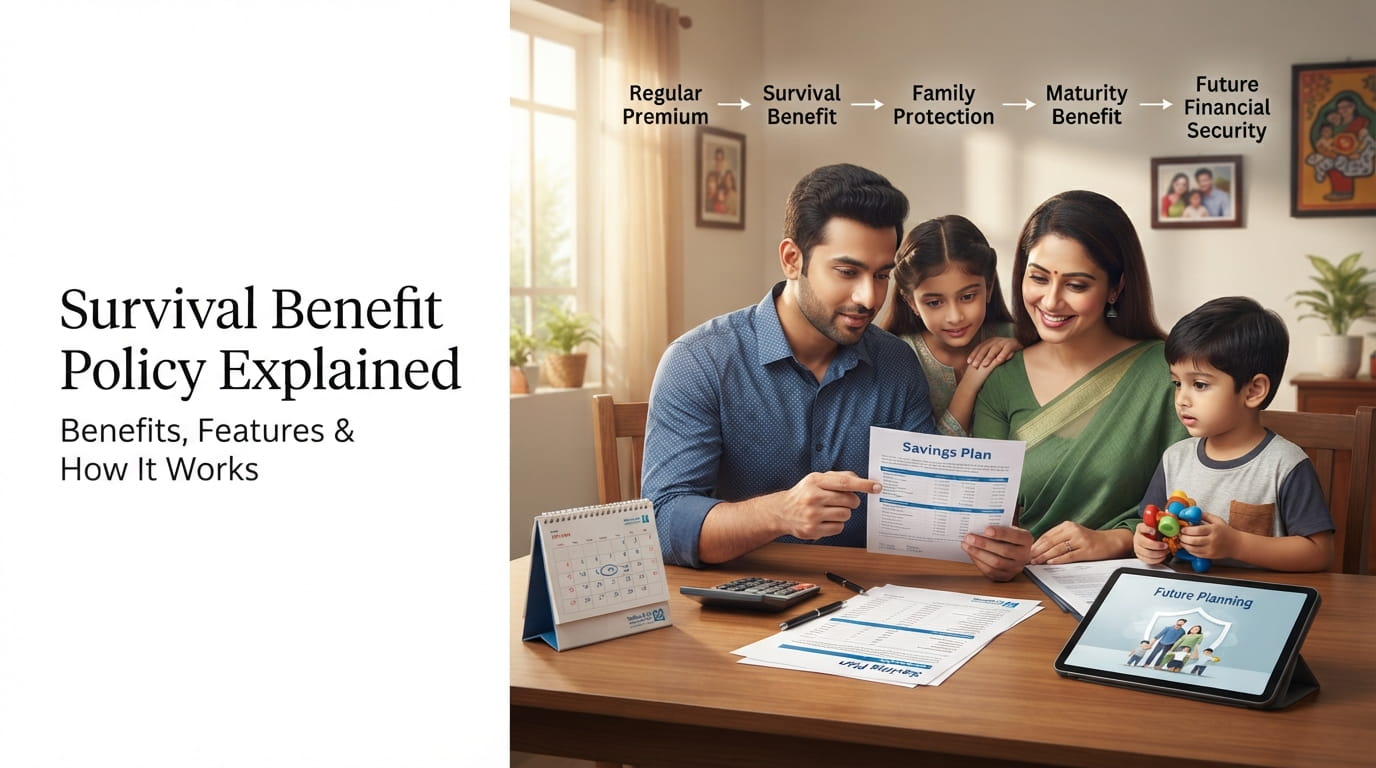
Survival Benefit Policy Explained: Benefits, Features & How It Works
Imagine a salaried professional in Bangladesh receiving their salary at the end of the month. First come the rent, groceries, utility bills, children's expenses, parents' needs, transport costs and other family responsibilities. Whatever remains often disappears into unexpected expenses.
Then comes a simple but important question:
“আমি যদি আজ থেকে নিয়মিত টাকা save করি, কয়েক বছর পর এই savings আমার family-এর জন্য কতটা useful হবে?”
This is where structured financial planning becomes important. Instead of saving only when money is left over, some people prefer a financial plan that encourages regular payments while also providing life insurance protection.
A Survival Benefit Policy is designed around this idea. Depending on the specific insurance plan, the policy may provide benefits when the insured survives specified periods and may also provide a maturity benefit at the end of the policy term. Where life insurance coverage is included, the plan can combine financial protection with long-term savings.
In this guide, we will explain what a Survival Benefit Policy is, how it works, its benefits and features, eligibility considerations, payment structure, maturity benefits, and how it compares with DPS and FDR. We will also look at how to choose a policy that matches your financial goals and where National Life Insurance PLC may fit into your planning.
🔷 What Is a Survival Benefit Policy?
A Survival Benefit Policy is a life insurance-linked financial plan that can provide specified benefits when the insured survives particular policy periods, subject to the selected plan's terms and conditions. Depending on the product, it may combine long-term savings, survival-related payments, maturity benefits and life insurance protection.
সহজভাবে বললে, আপনি একটি নির্দিষ্ট period-এর জন্য policy নেন এবং নিয়ম অনুযায়ী premium বা payment করেন। Policy active থাকা এবং applicable conditions পূরণ হলে নির্দিষ্ট সময়ের survival benefit বা maturity benefit পাওয়া যেতে পারে.
The exact benefit structure is not the same for every insurance product. Some plans may provide benefits at specific intervals, while others may primarily pay at maturity. Therefore, the policy document—not a general description—should always be treated as the final source for the actual benefits.
The concept is particularly relevant for people who want to build a disciplined long-term financial habit while considering protection for their family.
🔷 How Does a Survival Benefit Policy Work?
A Survival Benefit Policy generally works by combining regular premium payments with insurance coverage and benefits that become payable according to the policy schedule. Depending on the product, benefits may be payable at specified survival milestones and/or when the policy reaches maturity, subject to the policy's terms and conditions.
The basic process can be understood in six steps:
1. Choose an appropriate policy
First, you identify a policy based on your financial goal, desired policy duration, payment capacity and insurance needs.
2. Pay the required premium
You make premium payments according to the selected payment frequency. Depending on the product, payments may be monthly, quarterly, half-yearly or yearly.
3. Keep the policy active
Regular payment and compliance with policy conditions are important. Missing payments or allowing a policy to lapse can affect benefits, so the applicable policy rules should be understood before purchase.
4. Meet survival conditions
If the selected plan contains survival benefits, those benefits become payable according to the specified schedule when the insured survives the relevant period and other conditions are satisfied.
5. Reach maturity
When the policy reaches its stated maturity date, the applicable maturity benefit becomes payable according to the policy terms.
6. Protection during the policy term
Where life insurance coverage is included, the policy may also provide a death benefit to the nominee if the insured dies during the policy term, subject to the policy's conditions.
একটি সহজ example
ধরুন, একজন ব্যক্তি এমন একটি long-term insurance plan chooses করলেন যেখানে regular premium দিতে হয় এবং policy schedule অনুযায়ী নির্দিষ্ট survival benefits বা maturity benefit আছে।
তিনি নিয়মিত premium দিলেন এবং policy conditions মেনে চললেন। নির্দিষ্ট milestone-এ applicable survival benefit পেতে পারেন এবং policy maturity হলে applicable maturity benefit পেতে পারেন.
This is an illustrative example, not a quotation or guaranteed benefit.
🔷 What Are the Key Benefits of a Survival Benefit Policy?
The potential benefits of a Survival Benefit Policy include structured long-term savings, survival-related payments where applicable, maturity benefits, financial discipline and life insurance protection where included. The exact benefits depend on the specific policy, so buyers should review the benefit schedule, exclusions and conditions before making a decision.
A properly selected plan can support several financial objectives.
1. Structured long-term savings
Many people intend to save but struggle to maintain consistency.
এক মাস save করলেন, পরের মাসে family expense বেড়ে গেল—savings বন্ধ।
A regular insurance premium creates a structured financial commitment that can encourage disciplined saving over a longer period.
2. Survival-related benefits
Some insurance plans are designed to provide payments at specified survival milestones.
This can be useful when someone has planned future expenses around particular stages of life.
3. Maturity benefits
A policy may provide a maturity benefit when the insured survives until the end of the policy term, subject to the product's conditions.
The actual amount and components should always be checked in the policy illustration and contractual documents.
4. Life insurance protection
Where the selected plan includes life coverage, it can provide financial support to the nominee in the event of the insured's death, subject to applicable terms and conditions.
This is one important difference between an insurance-based savings plan and a simple savings arrangement.
5. Financial discipline
For someone who finds it difficult to save voluntarily, regular premium commitments can create a stronger savings habit.
6. Family financial planning
Parents and family earners can consider structured financial planning for future education, marriage, retirement or other long-term goals.
🔷 Key Features of a Survival Benefit Policy
Key features may include regular premium payments, a defined policy term, survival-related benefits, maturity benefits and life insurance protection, depending on the selected product. Other features, such as bonuses, loans or supplementary coverage, should only be considered when they are specifically stated in the policy terms.
Before buying a plan, pay attention to:
🔸Premium/payment structure: How much and how often do you need to pay?
🔸Policy term: How long will the policy remain in force?
🔸Survival benefit schedule: When are survival benefits payable?
🔸Maturity benefit: What becomes payable at maturity?
🔸Life coverage: What protection is provided?
🔸Bonus: Is any bonus applicable, and is it guaranteed or non-guaranteed?
🔸Nominee: Who receives applicable benefits after the insured's death?
🔸Exclusions: What situations are not covered?
🔸Loan or surrender rules: Are these facilities available, and under what conditions?
The key lesson is simple: don't judge an insurance plan only by the premium amount. Look at the complete benefit structure.
🔷 Who May Consider a Survival Benefit Policy?
A Survival Benefit Policy may be considered by people seeking structured long-term financial planning alongside life insurance protection, such as salaried professionals, parents, young earners and family financial planners. Suitability depends on income stability, financial goals, affordability, liquidity needs and the terms of the selected policy.
🔸 Salaried employees
If your income is relatively predictable, regular premiums may fit naturally into monthly financial planning.
🔸 Parents
Parents may use long-term financial planning to prepare for future education or other major family expenses.
🔸 Young professionals
Someone starting their career may want to develop disciplined saving habits early.
🔸 Business owners
Business income can fluctuate. A business owner should therefore carefully assess whether the premium commitment remains affordable during weaker income periods.
🔸 Long-term savers
If your goal is several years away, a long-term insurance-linked savings plan may be worth considering alongside other financial arrangements.
But remember: not everyone needs the same type of insurance. Your financial priorities should come first.
🔷 Who Is Eligible for a Survival Benefit Policy?
Eligibility depends on the specific insurance product and may include factors such as age, health, underwriting requirements, policy type, premium affordability and other insurer conditions. Because eligibility can vary from one plan to another, applicants should confirm the current requirements directly with the insurer before applying.
For example, National Life Insurance PLC publishes different eligibility and policy specifications for different products. Its published Endowment Insurance Plan, for example, lists specific entry-age, maturity-age, term and payment conditions.
So, rather than assuming that one age limit or policy term applies to every Survival Benefit-type plan, check the exact product documentation.
🔷 How Does the Payment or Premium Structure Work?
The payment structure depends on the selected policy and may involve regular premiums paid monthly, quarterly, half-yearly or annually. The right premium is one that you can maintain comfortably throughout the policy term without putting excessive pressure on your household budget.
Before choosing a premium, calculate your realistic monthly cash flow.
For example, ধরুন your household income is ৳60,000 per month. After rent, food, transport, utilities and family expenses, you may have a limited amount available for long-term savings.
Instead of selecting a premium simply because the future benefit looks attractive, ask:
🔸 Can I continue this payment during difficult months?
🔸Do I already have an emergency fund?
🔸 Will my children's expenses increase soon?
🔸Do I have existing loans?
🔸Do I need easy access to this money?
🔸What happens if I stop paying?
Illustrative example only: A person may decide to allocate a manageable portion of monthly income toward a long-term insurance plan. The actual premium and benefits must come from the selected policy quotation and official documents.
🔷What Are the Maturity Benefits?
Maturity benefit is the amount or benefit payable when the insured survives until the end of the policy term, subject to the specific policy conditions. Depending on the product, maturity benefits may include the applicable sum assured and other contractual or eligible benefits, such as bonuses where provided under the plan.
Maturity should not be confused with a bank deposit simply becoming larger through interest.
Insurance maturity benefits depend on the structure of the policy.
For example, National Life Insurance PLC's published Endowment Insurance Plan states that on survival until the end of the term, the full Sum Assured with accrued bonuses is payable, subject to the plan's terms.
This illustrates why product-specific documentation matters.
Before buying, ask for a written explanation of:
🔸Basic Sum Assured
🔸Applicable survival benefits
🔸Maturity benefit
🔸Bonus treatment
🔸Premium obligation
🔸Policy term
🔸Conditions and exclusions
Never assume that an example shown by an agent is a guaranteed outcome unless the policy documents clearly establish it.
🔷 Real-Life Example: A Bangladeshi Family Planning for the Future
Consider Rahim, a salaried professional living with his wife and two children.
His children are currently young. He expects education costs to increase over time and also wants to maintain financial protection for his family.
Instead of keeping all his savings in a regular account, he explores long-term financial planning.
🔷 His priorities are:
Building disciplined savings
Preparing for future education costs
Maintaining family protection
Creating a long-term financial goal
Avoiding a plan that is unaffordable
He compares different insurance and savings options, reads the policy terms and chooses only after understanding the premium commitment and applicable benefits.
The important point is not the specific product or amount. The lesson is that financial planning should start with the goal, not the sales pitch.
This is an illustrative example, not a quotation or guaranteed benefit.
🔷 Real-Life Example: A Young Bangladeshi Professional
Now consider Nusrat, a 27-year-old professional.
She has recently started earning a stable income. Her immediate expenses are manageable, but she also wants to prepare for future family responsibilities.
Her financial priorities include:
🔸Regular savings
🔸Family protection
🔸Future financial independence
🔸Building a long-term financial habit
Instead of asking only, “কত টাকা পাব?”, she asks a better question:
“এই policy আমার financial goal-এর সঙ্গে কতটা match করে?”
She reviews the policy term, premium schedule, benefits, exclusions and nominee arrangements before making a decision.
That approach is much healthier than choosing an insurance policy solely because its projected maturity amount looks attractive.
🔷 Survival Benefit Policy vs DPS: What's the Difference?
A Survival Benefit Policy and a DPS can both help you build disciplined savings, but they are fundamentally different financial arrangements. A DPS is primarily a deposit-based savings product, while an insurance policy combines financial planning with life insurance protection and policy-specific benefits. Which option is more suitable depends on your financial goals, liquidity needs, protection requirements, and the specific terms of the product.
A DPS is generally designed for people who want to save a fixed amount regularly over a predetermined period. The focus is mainly on building savings through consistent deposits. The maturity amount and other benefits depend on the terms and conditions of the bank or financial institution offering the DPS.
A Survival Benefit Policy, on the other hand, is an insurance-based financial plan. Depending on the policy, it may provide survival benefits at specified stages, along with life insurance coverage. Regular premium payments can help create financial discipline while the policy provides benefits according to its terms.
The key difference is therefore the purpose of the financial arrangement. A DPS primarily focuses on regular savings, whereas a Survival Benefit Policy can combine long-term savings or survival benefits with life insurance protection.
For example, if your primary goal is simply to set aside money every month and you may need relatively easier access to your savings according to the scheme's rules, a DPS may be worth considering. But if you want to build long-term financial security while also having life insurance protection, an insurance-based plan may be more relevant.
Another important consideration is liquidity. DPS withdrawal rules depend on the bank or financial institution and the specific scheme. Insurance policies can also have specific rules regarding surrender, withdrawal, premium payment, and other policy benefits. Therefore, you should always review the policy or scheme terms before making a decision.
So, Is a Survival Benefit Policy Better Than DPS?
Not universally. The better option depends on what you want your money to achieve.
If your main objective is straightforward, regular savings, a DPS may deserve consideration. If you also want life insurance protection, structured long-term financial planning, and policy-specific survival or maturity benefits, a Survival Benefit Policy may be more suitable.
Before choosing either option, compare the payment commitment, maturity benefits, protection, liquidity, policy or scheme terms, and your long-term financial goals. A well-informed decision should match your savings capacity today with the financial protection and goals you have for tomorrow.
🔷 Survival Benefit Policy vs FDR: Which One Should You Choose?
A Survival Benefit Policy and an FDR serve different purposes. An FDR is primarily a fixed-term deposit, while an insurance policy can combine financial protection with policy-specific savings or maturity benefits. The right choice depends on your need for insurance, liquidity, time horizon, financial goals and the current terms offered by each provider.
Consider these differences:
🔸Purpose: FDR is primarily a deposit product; insurance combines protection with policy benefits.
🔸 Protection: An FDR does not function as life insurance.
🔸Liquidity: Early withdrawal rules differ and should be checked.
🔸Tenure: Both can have defined periods, but insurance contracts may involve longer commitments.
🔸Benefits: FDR returns depend on deposit terms; insurance benefits depend on the policy contract.
🔸Financial planning: Insurance can address both protection and long-term planning when appropriately structured.
If you need short-term liquidity, locking money into a long-term insurance contract may not be appropriate. আবার, if family protection is an important priority, comparing only the maturity amount may miss a major part of the picture.
🔷 How to Choose the Right Survival Benefit Policy
Choose a Survival Benefit Policy by first identifying your financial goal, then comparing the policy term, premium affordability, insurance coverage, survival benefit schedule, maturity benefit, exclusions, nominee arrangements and insurer service. Never choose solely on an advertised maturity amount or premium; understand the complete contractual terms first.
Use this practical checklist:
1. Define your goal
Are you saving for education, marriage, retirement or general family financial planning?
2. Check affordability
The premium should fit comfortably within your budget.
3. Understand the policy duration
A long-term policy requires a long-term commitment.
4. Examine the life coverage
Understand exactly what protection your family receives.
5. Review survival benefits
Know when benefits are payable and what conditions apply.
6. Understand maturity benefits
Ask for the complete maturity calculation and distinguish guaranteed components from non-guaranteed benefits.
7. Read exclusions
Never skip the exclusions section.
8. Check nominee arrangements
Make sure nominee information is properly understood and maintained.
9. Ask about surrender and loan facilities
If available, understand when these facilities become available and how they affect your policy.
10. Evaluate the insurer
Consider the insurer's experience, product range, customer service and official documentation.
🔷 Why Consider National Life Insurance PLC?
National Life Insurance PLC can be considered by Bangladeshi customers looking for established life insurance solutions and long-term financial planning options. The company states that it began operations in 1985 and offers a diversified range of life assurance products, including endowment, anticipated endowment, pension, whole life, child-focused and savings-oriented plans.
National Life Insurance PLC's official product information shows that its portfolio includes products such as Endowment Insurance, Three Payments Anticipated Endowment Insurance, Five Payments Anticipated Endowment Insurance, Pension Insurance, Whole Life Policy, Monthly Savings Insurance, Children Education Security Plan and other insurance solutions.
Its published Endowment Insurance Plan also demonstrates how an insurance savings product can combine protection and maturity-related benefits: the official document states that the basic Sum Assured with accrued bonuses is payable when the insured survives to the end of the term, while a death benefit is payable to nominees if the insured dies during the policy term, subject to policy conditions.
National Life Insurance PLC's official website also provides policy application facilities and customer contact information for people who want to explore available options.
The best approach is not to buy a policy simply because a company has a wide product range. Instead, compare the available plan with your own financial goals, affordability and protection needs.
🔷 A Smart Next Step Before Buying
If you are considering a Survival Benefit Policy, don't rush straight to the application form.
First, make a simple list:
My goal → My budget → My preferred term → My protection need → My required flexibility
Then ask the insurer or authorized representative to explain the policy in plain language.
You should understand:
🔸What exactly am I paying?
For how long?
🔸What benefits are guaranteed?
🔸Which benefits depend on bonuses or other conditions?
🔸What happens if I miss a payment?
🔸What happens if I surrender the policy?
🔸What does my nominee receive?
🔸What happens at maturity?
এই questions-এর clear answer পাওয়ার পর decision নিলে আপনার choice অনেক বেশি informed হবে।
If National Life Insurance PLC has a policy that matches your needs, you can explore its available insurance solutions and speak with an authorized representative before making a commitment.
🔷7 Common Mistakes to Avoid When Buying a Survival Benefit Policy
Direct Answer:
The most common mistakes include choosing a policy based only on the maturity amount, failing to understand survival-benefit timing, ignoring exclusions, overlooking premium affordability and not checking what happens if premiums stop. Buyers should review the complete policy terms and benefit illustration before making a long-term commitment.
1. Looking only at maturity amount
A large projected amount doesn't automatically mean the policy is appropriate.
2. Ignoring liquidity
You may need money before maturity.
Understand surrender and withdrawal rules.
3. Confusing projected bonuses with guaranteed benefits
Ask which figures are contractual and which are illustrations.
4. Choosing an unaffordable premium
A policy is only useful if you can maintain it.
5. Not understanding death benefits
Family protection is a major part of life insurance.
6. Ignoring exclusions
Read the exclusions before signing.
7. Buying because of sales pressure
Don't purchase simply because an agent says:
“এই policy এখনই নিতে হবে।”
Take time to understand the contract.
🔷 Conclusion
A Survival Benefit Policy is not simply about saving money for the future. Depending on the product, it can bring together structured long-term savings, survival-related benefits, maturity benefits and life insurance protection.
But the most important lesson is this: there is no single insurance policy that is automatically right for everyone.
আপনার income, family responsibilities, future goals, liquidity needs and ability to maintain premiums should guide your decision.
If you're comparing a Survival Benefit Policy with DPS or FDR, don't ask only:
“Which one gives me more money?”
Also ask:
“Which option better matches my financial goal and protection needs?”
That small change in thinking can lead to much better financial decisions.
For readers considering life insurance in Bangladesh, National Life Insurance PLC offers a broad range of insurance solutions that can be explored according to different financial and life-stage needs.
Understand the policy. Compare the terms. Check affordability. Then choose with confidence.
🔷 Frequently Asked Questions About Survival Benefit Policy
1. What is a Survival Benefit Policy?
A Survival Benefit Policy is an insurance-linked financial plan that may provide specified benefits when the insured survives particular policy periods. Depending on the product, it may include survival payments, maturity benefits and life insurance protection. Actual benefits depend on the selected policy's terms and conditions.
2. How does a Survival Benefit Policy work?
You pay premiums according to the selected payment schedule and keep the policy active by meeting its conditions. If the plan provides survival benefits, applicable payments may become due at specified milestones. At maturity, the applicable maturity benefit becomes payable according to the policy contract.
3. What are the main benefits of a Survival Benefit Policy?
Potential benefits include disciplined long-term savings, survival-related payments, maturity benefits and life insurance protection where included. Some products may also provide additional contractual features. However, benefits vary between policies, so readers should review the official benefit schedule and terms before making a decision.
4. What is a survival benefit in life insurance?
A survival benefit is a payment or benefit that may become payable when the insured survives a specified period under a policy that includes such a feature. The timing, amount and conditions depend entirely on the selected insurance product and its contractual terms.
5. What are maturity benefits?
Maturity benefits are the benefits payable when the insured survives until the end of the policy term, subject to the policy conditions. Depending on the product, these may include a specified Sum Assured and applicable bonuses or other benefits. The exact maturity value should be confirmed from official policy documents.
6. Who can consider a Survival Benefit Policy?
People who want structured long-term financial planning alongside life insurance protection may consider this type of policy. Salaried employees, parents, young professionals and long-term savers may find it relevant. However, suitability depends on individual financial circumstances, affordability, goals, liquidity requirements and the selected policy.
7. How are premiums paid?
Premium payment frequency depends on the specific insurance product. Some plans may allow monthly, quarterly, half-yearly or yearly payments. The important consideration is affordability and consistency. Before buying, confirm the exact premium amount, payment frequency, due dates and consequences of missed payments.
8. What happens when the policy matures?
When an insured person survives until the policy's maturity date, the applicable maturity benefit becomes payable according to the policy terms. The benefit may include contractual amounts and, where applicable, bonuses or other benefits. The exact amount should never be assumed without reviewing the policy documents.
9. Is a Survival Benefit Policy the same as DPS?
No. A DPS is primarily a deposit-based savings arrangement, whereas an insurance policy is designed around insurance protection and contractual policy benefits. A Survival Benefit Policy may provide life coverage in addition to savings-related benefits. The better choice depends on the person's financial goals and needs.
10. What is the difference between Survival Benefit Policy and FDR?
An FDR is primarily a fixed-term deposit, while a Survival Benefit Policy is an insurance contract that may combine protection with savings-related and maturity benefits. They also differ in liquidity, contractual structure and financial purpose. Compare the current terms of both before choosing one.
11. Is life insurance included in a Survival Benefit Policy?
Life insurance protection may be included, depending on the specific policy. If included, the policy can provide a death benefit to the nominee when the insured dies during the policy term, subject to applicable conditions. Always confirm the exact coverage from the policy document.
12. What should I check before buying a policy?
Check the policy term, premium amount and frequency, life coverage, survival benefit schedule, maturity benefit, exclusions, surrender conditions, loan facilities if available, nominee arrangements and guaranteed versus non-guaranteed benefits. Most importantly, make sure the premium is affordable throughout the intended policy term.
13. Can a Survival Benefit Policy help with long-term financial goals?
It may help provide financial structure for long-term goals by combining regular premium commitments with policy-specific benefits. People may consider such planning for education, marriage, retirement or family financial security. However, the policy should match the goal, timeline and affordability of the individual.
14. Why consider National Life Insurance PLC?
National Life Insurance PLC has operated in Bangladesh since 1985 and offers a diversified range of life insurance products, including endowment, pension, whole life, child-focused and savings-oriented solutions. Customers should review the specific product terms and speak with an authorized representative before making a decision.
15. Where can I learn more about available insurance policies?
You can explore the official National Life Insurance PLC website for information about its insurance solutions, company information and policy application facilities. Before purchasing, review the relevant policy documents and discuss your requirements with an authorized representative.
← Back to Insights
NLI Archive / 2026
Trending Analysis
Survival Benefit Policy Explained: Benefits, Features & How It Works
N
NLI Editorial
© National Life Insurance Co. Ltd.
Share:
FB
LN