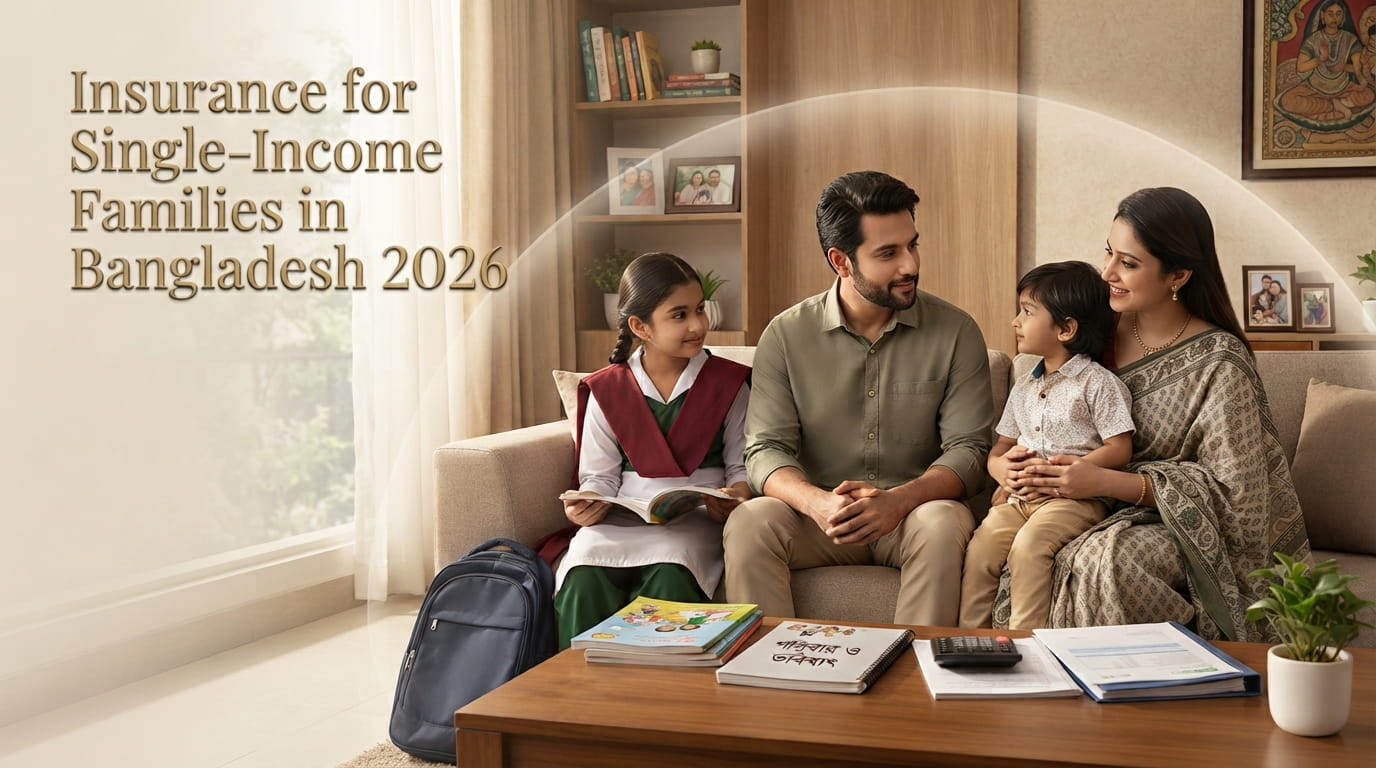
Insurance for Single-Income Families in Bangladesh: Affordable Coverage & Financial Protection Guide
Imagine a family in Bangladesh where only one person earns the household income.
Every month, that income pays for food, rent, children's education, electricity, transport, medicine, loan payments, and other daily needs. The spouse may manage the home, while the children depend fully on the parent's income.
From the outside, everything may look normal.
কিন্তু পরিবারের সবচেয়ে বড় financial risk অনেক সময় চোখে দেখা যায় না।
যদি পরিবারের main earner হঠাৎ মারা যান, তাহলে সংসারের খরচ কীভাবে চলবে?
এই প্রশ্নের উত্তর শুধু savings দিয়ে সবসময় দেওয়া সহজ নয়। বিশেষ করে যখন monthly income-এর বড় অংশ already household expenses-এ চলে যায়।
This is where insurance for single-income families in Bangladesh can become an important part of financial planning.
Life insurance cannot remove the emotional loss of a loved one. But, depending on the policy, it can provide financial benefits that may help eligible family members manage important expenses after the insured person's death.
The goal is not to buy the most expensive policy.
The goal is to choose protection that matches the family's needs, budget, and long-term responsibilities.
🔷 What Is Insurance for Single-Income Families in Bangladesh?
Short answer: Insurance for a single-income family is financial protection designed to help dependents manage financial needs if the family's primary earner dies or another covered event occurs, depending on the policy terms.
A single-income household normally has one main source of earned income.
For example:
🔸Husband earns and wife manages the household.
🔸Wife earns while husband manages the home.
🔸One parent works while children depend on that income.
🔸One adult supports a spouse, children, or dependent parents.
In such families, the financial impact of losing the main earner can be much larger because there may not be another regular income source.
ধরুন, একজন ব্যক্তি মাসে ৳35,000 আয় করেন। এই টাকা দিয়ে family-এর food, rent, school fees, electricity, transport এবং other expenses চলে।
If that income suddenly stops, the family does not lose only a salary.
They may also lose the money needed for:
🔸Children's education
🔸Housing
🔸Food
🔸Utility bills
🔸Healthcare
🔸Loan repayment
🔸Future savings
🔸Emergency needs
That is why life insurance for single-income families is mainly about managing financial dependency.
🔷 Why Is Life Insurance Important for a Single-Income Family?
Short answer: A single-income family may have a greater financial dependency on one person. Life insurance can provide an eligible benefit under the policy if the insured person dies, helping the family manage financial responsibilities according to the policy terms.
1. It Can Help Address Lost Income
The biggest concern is often income replacement.
If the main earner dies, the family may suddenly have regular expenses but no regular salary.
A life insurance benefit may help create a financial cushion.
It does not necessarily replace the person's income forever. Instead, the benefit can help the family manage the financial gap while they adjust their situation.
2. It Can Support Children's Education Planning
For parents, children's education is a major long-term responsibility.
স্কুলের খরচ, college, university বা future education—এসব expense একদিনে শেষ হয় না।
If the main earner dies, education planning may become difficult.
Depending on the policy structure, a child-focused insurance or education-related plan may be considered as part of a broader financial plan.
National Life Insurance PLC currently lists Child Insurance among its product categories, while its published annual report also lists child protection and children's education-related insurance products.
3. It Can Help With Debt and Financial Obligations
Some families have:
🔸Home loans
🔸Personal loans
🔸Business-related debt
🔸Education-related borrowing
🔸Informal family obligations
If the primary earner dies, these obligations may continue.
When estimating protection needs, outstanding debt should therefore be considered.
4. It Can Help Protect Housing and Daily Living
A family needs a place to live even after losing its main income.
Insurance benefits, where applicable, may help eligible beneficiaries manage housing-related and everyday financial needs.
5. It Can Strengthen Long-Term Family Financial Security
Financial security is not only about today's food bill.
It also includes:
🔸Children's future
🔸Emergency needs
🔸Debt management
🔸Retirement planning
🔸Long-term savings
🔸Family responsibilities
For a single-income household, having a financial protection plan can reduce dependence on one income source.
🔷 What Risks Does a Single-Income Family Face Without Insurance?
Without appropriate financial protection, the family may face several challenges after losing the primary earner.
🔸 Sudden Income Loss
The most obvious problem is loss of monthly cash flow.
🔸 Reduced Education Budget
Parents may have to reduce education-related spending because essential household expenses come first.
🔸 Debt Pressure
Existing loans or financial obligations may continue.
🔸 Emergency Savings Can Disappear Quickly
A small emergency fund may help for a short period, but it may not cover years of family responsibilities.
🔸 Dependence on Relatives
পরিবারকে আত্মীয়স্বজনের financial support-এর ওপর নির্ভর করতে হতে পারে।
That may not always be sustainable.
🔷 Future Goals May Be Delayed
Plans such as:
🔸Children's higher education
🔸Buying a home
🔸Starting a business
🔸Retirement preparation
may become harder.
The important point is simple:
The more people depend on one income, the more important it becomes to think about what happens if that income suddenly stops.
🔷 What Types of Insurance May Suit Single-Income Families?
There is no single “best insurance” for every family.
The right choice depends on the family's:
🔸Income
🔸Age
🔸Number of dependents
🔸Financial goals
🔸Existing savings
🔸Debt
🔸Budget
🔸Desired protection period
🔸Policy terms
National Life Insurance PLC's current website lists categories including Child Insurance, Pension Policy, Savings Policy, DPS, Whole Life, Survival Benefit, Islami Takaful, FDR and Group Insurance.
Here is how different categories may fit different goals.
🔷 Protection-Focused Life Insurance
If your main concern is:
“আমার কিছু হলে family কীভাবে financially survive করবে?”
then protection should be the first question.
A protection-focused policy is generally considered around the financial risk created by the death of the insured person.
The exact benefit, term, premium and conditions depend on the specific policy.
🔷 Whole Life Insurance
Whole Life Insurance may be considered by people looking for long-term life protection.
It may be relevant when the financial goal extends beyond a limited working period.
However, do not assume every Whole Life policy works in exactly the same way.
Before buying, check:
🔸Coverage
🔸Premium structure
🔸Policy duration
🔸Applicable benefits
🔸Exclusions
🔸Conditions
🔸Maturity or other applicable benefits
🔷 Savings-Oriented Insurance
Some life insurance products combine insurance protection with a savings or maturity component.
These may appeal to families who want:
Protection + disciplined long-term financial planning
But savings-oriented insurance should not automatically be treated as equivalent to a simple deposit or DPS.
Understand what the actual policy provides.
🔷 Child Insurance
If children's future is a major concern, child-focused insurance may be worth exploring.
National Life Insurance PLC lists Child Insurance as a current product category and its annual report includes child protection and children's education-related plans.
The important question is:
What financial problem is the child-focused policy designed to solve?
Look at the actual policy terms instead of choosing a product simply because its name sounds suitable.
🔷 Pension-Oriented Insurance
A single-income family should also think about the future of the main earner.
Retirement can create another income gap.
Pension-oriented insurance may be considered as part of a broader retirement plan.
National Life Insurance PLC lists Pension Policy among its current product categories.
🔷 Islamic Takaful
Some families prefer a Shariah-oriented financial protection structure.
For them, Islami Takaful may be an option to explore.
National Life Insurance PLC currently lists Islami Takaful among its services.
Before choosing one, understand the specific Takaful structure, contribution requirements, benefits, exclusions and applicable conditions.
🔷 Group Insurance
If the primary earner is an employee, check whether their employer already provides Group Insurance.
National Life Insurance PLC's published product information includes Group Insurance categories such as Group Term, Group Endowment, Group Economy and Group Anticipated Insurance.
However, an employee should understand:
🔸How much coverage exists
🔸Who is covered
🔸What events are covered
🔸Whether dependents are included
🔸What happens when employment ends
Employer-provided insurance may not be enough for every family's needs.
🔷 How Much Life Insurance Coverage Does a Single-Income Family Need?
Short answer: There is no universal coverage amount for every single-income family. A practical estimate should consider income, dependents, debt, children's future costs, existing savings, housing needs, financial goals, and what premium the family can sustainably afford.
A simple framework is:
Coverage need ≈ financial responsibilities + future family needs − existing financial resources
This is only an illustrative planning framework, not a universal insurance formula.
Step 1: Calculate Essential Family Expenses
Start by calculating your family’s essential monthly expenses. This helps you understand how much money your household needs to maintain its basic lifestyle if the main income earner is no longer able to provide income.
For example, a family might spend around ৳12,000 on food, ৳10,000 on rent, ৳5,000 on education, ৳3,000 on utilities, ৳3,000 on transport, and ৳2,000 on healthcare and other necessary costs. Together, these expenses would be approximately ৳35,000 per month.
These figures are hypothetical examples only. Your actual family expenses may be higher or lower depending on your location, family size, lifestyle, children's education, rent, healthcare needs, and other financial responsibilities.
Once you know your essential monthly expenses, you can use this amount to estimate how much life insurance coverage your family may need to maintain financial stability.
Step 2: Think About How Long the Family May Need Support
Ask:
🔸How old are the children?
🔸Is the spouse earning?
🔸Are parents financially dependent?
🔸How many years of education remain?
🔸Is there a housing cost?
🔸Is there outstanding debt?
A family with three young children may have different protection needs from a couple with no children.
Step 3: Add Outstanding Debt
Suppose the family has an outstanding loan.
That financial obligation should be considered separately rather than ignored.
Step 4: Consider Existing Savings
If the family already has:
🔸Emergency savings
🔸Fixed deposits
🔸Investments
🔸Other insurance
🔸Employer-provided coverage
these resources may reduce the amount of additional protection required.
Step 5: Consider Future Goals
Think beyond today's expenses.
For example:
Children's education + family living costs + debt + emergency needs + future goals
This gives a better picture than simply multiplying monthly income by an arbitrary number.
🔷 A Simple Example
Suppose a fictional single-income family has:
🔸 One main earner
🔸Spouse with no regular income
🔸Two children
🔸Monthly household expenses of ৳40,000
🔸Some outstanding debt
🔸Limited savings
Instead of asking:
“Which policy has the lowest premium?”
the family should first ask:
“If my income stops, how much money would my family realistically need?”
That is the better starting point.
🔷 How Can Low-Income Families Afford Life Insurance?
For a low-income family, affordability matters.
Insurance should not become a financial burden that makes it impossible to pay for food, rent or essential healthcare.
Start With the Family Budget
Write down:
🔸Monthly income
🔸Essential expenses
🔸Debt payments
🔸Existing savings
🔸Emergency fund
🔸Amount available for long-term protection
🔸Prioritize Essential Protection
Do not try to buy every possible feature.
First ask:
What is the biggest financial risk my family needs to protect against?
For many single-income households, that may be the loss of the primary earner.
🔷 Choose Coverage You Can Maintain
A policy is only useful if you can continue meeting its premium obligations according to the policy terms.
So affordability means more than:
“Can I pay the first premium?”
It means:
“Can I realistically continue paying according to the policy schedule?”
🔷 Do Not Focus Only on the Lowest Premium
A very low premium may come with different coverage, conditions, duration or benefits.
Compare the complete policy.
Review Before Buying
Ask for clear information about:
🔸Premium
🔸Coverage
🔸Term
🔸Benefits
🔸Exclusions
🔸Eligibility
🔸Payment schedule
🔸Lapse-related conditions
🔸Surrender-related conditions
🔸Claim requirements
🔷 Affordable Insurance vs Cheap Insurance
Cheap insurance and affordable insurance may sound like the same thing, but they are not.
Cheap insurance mainly focuses on getting the lowest possible premium. The price may be low, but the coverage or benefits may not always match your family’s actual needs.
Affordable insurance focuses on something more important: useful protection that your family can realistically afford over the long term. The premium should fit your budget, while the coverage should provide meaningful financial protection.
For example, a policy with the lowest premium may look attractive at first. But if its coverage is too limited, it may not provide enough financial support when your family needs it most. On the other hand, a slightly higher premium may offer more suitable protection while still remaining manageable within your monthly budget.
So, when choosing insurance, don't ask only:
“Which policy has the lowest premium?”
Instead, ask:
“Does this policy provide enough protection for our financial risks, and can we continue paying the premium regularly?”
In simple words, cheap means low price, while affordable means a manageable cost for useful and sustainable protection.
For a family, the lowest premium is not always the best decision. The right policy should balance premium, coverage, benefits, affordability, and long-term financial needs.
🔷 How to Choose the Right Insurance for a Single-Income Family
Use this simple checklist.
1. Identify the Main Earner
Who generates most of the household income?
2. List All Dependents
Include:
🔸Spouse
🔸Children
🔸Dependent parents
🔸Other family members who rely on the income
3. Calculate Essential Expenses
Separate needs from wants.
4. Identify Debt
Write down outstanding loans and other financial obligations.
5. Check Existing Protection
You may already have:
🔸Employer Group Insurance
🔸Existing Life Insurance
🔸Savings
🔸FDR
🔸Other financial resources
6. Decide Your Main Goal
Your main goal may be:
🔸Family income protection
🔸Children's education
🔸Long-term savings
🔸Retirement planning
🔸Whole-life protection
🔸Shariah-oriented protection
7. Compare Policies
Do not compare premium alone.
Compare:
🔸Coverage
🔸Benefits
🔸Term
🔸Premium
🔸Exclusions
🔸Payment conditions
🔸Claim requirements
🔸Other applicable terms
8. Read the Actual Policy Documents
This is one of the most important steps.
A sales explanation is not a substitute for the policy document.
🔷 What Should You Check Before Buying a Policy?
Before signing up, ask these questions.
🔸 Coverage
What exactly is covered?
🔸Premium
How much do I need to pay and how often?
🔸Policy Term
How long does the policy remain active?
🔸Benefits
What benefits apply, and under what conditions?
🔸Exclusions
What situations are not covered?
🔸Eligibility
Do I meet the age, health, income or other applicable requirements?
🔸Claim Process
What documents may be needed to make a claim?
🔸Nominee
Who is nominated to receive the applicable policy benefit?
Under Bangladesh's Insurance Act 2010, a life policyholder may nominate a person or persons to whom money secured by the policy is to be paid in the event of death, subject to the law and applicable process.
So, keep nominee information updated and make sure your family understands where important policy documents are kept.
🔸Premium Payment Obligations
Understand what happens if you miss or stop premium payments.
🔸Surrender/Lapse-Related Terms
If your financial situation changes, you should know what the policy says about discontinuation, surrender or other consequences.
IDRA also identifies policyholder interests involving nomination, insurable interest, surrender value and other policy conditions as part of its regulatory responsibilities.
🔷Common Mistakes Single-Income Families Should Avoid
Mistake 1: Choosing Only by Premium
“এইটার premium কম” is not enough.
Look at the whole policy.
Mistake 2: Buying Too Little Coverage
A small policy may be affordable but may not address the family's actual financial gap.
Mistake 3: Ignoring Dependents
Do not calculate coverage based only on your personal expenses.
Think about everyone who depends on your income.
Mistake 4: Forgetting Education Costs
Children may depend on family income for many years.
Mistake 5: Ignoring Existing Debt
Loans do not automatically disappear when income stops.
Mistake 6: Not Reading Exclusions
Always understand what is and is not covered.
Mistake 7: Missing Premium Payments
A policy requires you to follow its payment conditions.
Mistake 8: Keeping the Policy Information Secret
Your spouse or trusted family member should know:
🔸Insurer name
🔸Policy number
🔸Important documents
🔸Nominee details
🔸Premium schedule
🔸Contact information
Mistake 9: Buying a Product Without Understanding the Goal
Do not start with:
“Which product should I buy?”
Start with:
“What financial problem am I trying to solve?”
🔷 What Financial Risks Does a Single-Income Family Face?
A single-income family has a unique financial structure: one person's income may support most of the household's needs.
That does not automatically mean the family is financially unsafe. But it can create a concentration of financial risk.
If the main earner cannot continue earning because of a serious life event, the family may suddenly face several challenges at the same time.
Common financial risks include:
🔸Loss of regular household income
🔸Difficulty managing monthly living expenses
🔸Children's education costs
🔸Outstanding loans or debts
🔸Housing expenses
🔸Medical or other unexpected costs
🔸Financial support for dependent parents
🔸Reduced ability to maintain existing savings goals
This is why financial protection should be considered as part of a wider family financial plan.
The key issue is not simply how much a family earns. It is how dependent the household is on that income.
🔷 If You Are the Only Person Earning, Who Protects Your Family?
Imagine a family where one person earns and everyone else depends on that income.
Every month, that income pays for food, rent, children's education, utility bills, transportation, loan payments, and other family needs.
Now imagine one unexpected event changes everything.
The question is not only:
“How much money do I earn?”
A more important question may be:
“What happens to my family if I can no longer earn?”
This is where financial protection becomes important.
Life insurance cannot replace a person's presence, care, or responsibilities. But an appropriate policy may provide eligible financial benefits according to its terms, helping the family manage some of the financial pressure created by a covered event.
For a single-income family, that protection can be part of a responsible financial plan.
🔷 Your Biggest Financial Asset May Not Be Your Savings
When people think about their biggest financial assets, they often think about savings, property, investments, or a business.
But for many working families, there is another valuable asset:
🔸 Future income.
Consider a person who expects to earn and support the family for many more years.
That future income may pay for:
🔸Daily household expenses
🔸Children's education
🔸Housing
🔸Loan payments
🔸Parents' support
🔸Future family goals
If that income suddenly disappears, the financial impact can be much larger than the family's current savings.
This is why life insurance is often discussed as a financial protection tool rather than simply another financial product.
🔷 How to Build a Financial Safety Net for a Single-Income Family
Life insurance is only one part of family financial protection.
A stronger financial safety net can include several layers:
Layer 1: Monthly Budget
Know where your household income goes each month.
Layer 2: Emergency Savings
Build accessible savings for unexpected short-term expenses.
Layer 3: Insurance Protection
Consider appropriate insurance to manage major financial risks covered by the policy.
Layer 4: Debt Management
Understand and manage outstanding financial obligations.
Layer 5: Long-Term Planning
Plan for children's education, retirement, major purchases, and other future goals.
Think of it as:
Income → Budget → Emergency Fund → Insurance → Long-Term Goals
The exact balance will depend on your family's circumstances.
🔷 How National Life Insurance PLC Can Help Families Explore Financial Protection
National Life Insurance PLC provides a range of insurance categories for different financial needs. Its current product page lists Child Insurance, Pension Policy, Savings Policy, DPS, Whole Life, Survival Benefit, Islami Takaful, FDR and Group Insurance.
Its published annual report also describes a broader portfolio that includes endowment insurance, child protection, children's education security, pension insurance, whole life, monthly savings, family savings and income insurance, Takaful products and group insurance.
That variety can be useful because every single-income family has a different problem.
For example:
Your main goal Category you may explore
Protect dependents Life insurance/protection-oriented options
Long-term protection Whole Life
Child's future Child Insurance
Long-term saving Savings-oriented options
Retirement planning Pension Policy
Shariah-oriented protection Islami Takaful
Employer-based protection Group Insurance
This table is a general guide, not a product recommendation. Actual suitability depends on the policy terms and your financial circumstances.
The official National Life website provides product information and contact options for people who want to explore available plans.
Talk to an Insurance Advisor
If you are unsure where to start, discuss your situation with an insurance advisor.
Before choosing a policy, explain:
🔸Your monthly income
🔸Number of dependents
🔸Children's ages
🔸Major expenses
🔸Outstanding debt
🔸Existing savings
🔸Existing insurance
🔸Your main financial goal
🔸What premium you can realistically maintain
The purpose of the conversation should be to understand the available options—not simply to buy the first policy presented to you.
🔷 A Simple Financial Protection Checklist for Single-Income Families
Before buying insurance, ask yourself:
🔸Who depends on my income?
🔸What happens to my family if my income stops?
🔸How much does my family spend every month?
🔸How much debt do I have?
🔸How much emergency savings do I have?
🔸What education costs may come in the future?
🔸Do I already have employer-provided insurance?
🔸How much premium can I comfortably maintain?
🔸What type of insurance matches my main goal?
🔸Have I read the exclusions?
🔸Have I checked the policy term?
🔸Is my nominee information correct?
🔸Does my spouse/family know about the policy?
🔸Have I checked the latest official policy document?
If you cannot answer these questions, take a little more time before making a decision.
🔷 Final Takeaway
For a single-income family, the main financial risk is not simply having a low income.
The bigger risk can be losing the one income that the entire family depends on.
That is why insurance for single-income families in Bangladesh should be viewed as part of a wider financial protection plan.
The right approach is:
Understand your risk → calculate your responsibilities → set a realistic budget → compare suitable insurance options → read the policy terms → keep nominee and policy information updated.
You do not need to choose the most expensive insurance.
You need to choose protection that makes sense for your family's actual financial situation and that you can maintain according to the policy terms.
For families exploring available options, National Life Insurance PLC provides multiple insurance categories covering areas such as family protection, children, savings, retirement, Whole Life, Takaful and group insurance.
Your family's financial protection starts with understanding the risk.
Talk to an Insurance Advisor
If you are considering life insurance for your family, speak with an advisor to understand the available options, applicable benefits, premium requirements, exclusions and policy conditions before making a decision.
Financial Information Disclaimer
This article is for general financial and educational information only. It is not personalized financial advice and does not guarantee that any particular insurance product is suitable for every family. Product features, premiums, eligibility, benefits, exclusions, maturity conditions, claim requirements and other policy terms can vary. Always review the latest official policy documents and applicable terms before purchasing an insurance policy.
← Back to Insights
NLI Archive / 2026
Trending Analysis
Insurance for Single-Income Families in Bangladesh 2026
N
NLI Editorial
© National Life Insurance Co. Ltd.
Share:
FB
LN