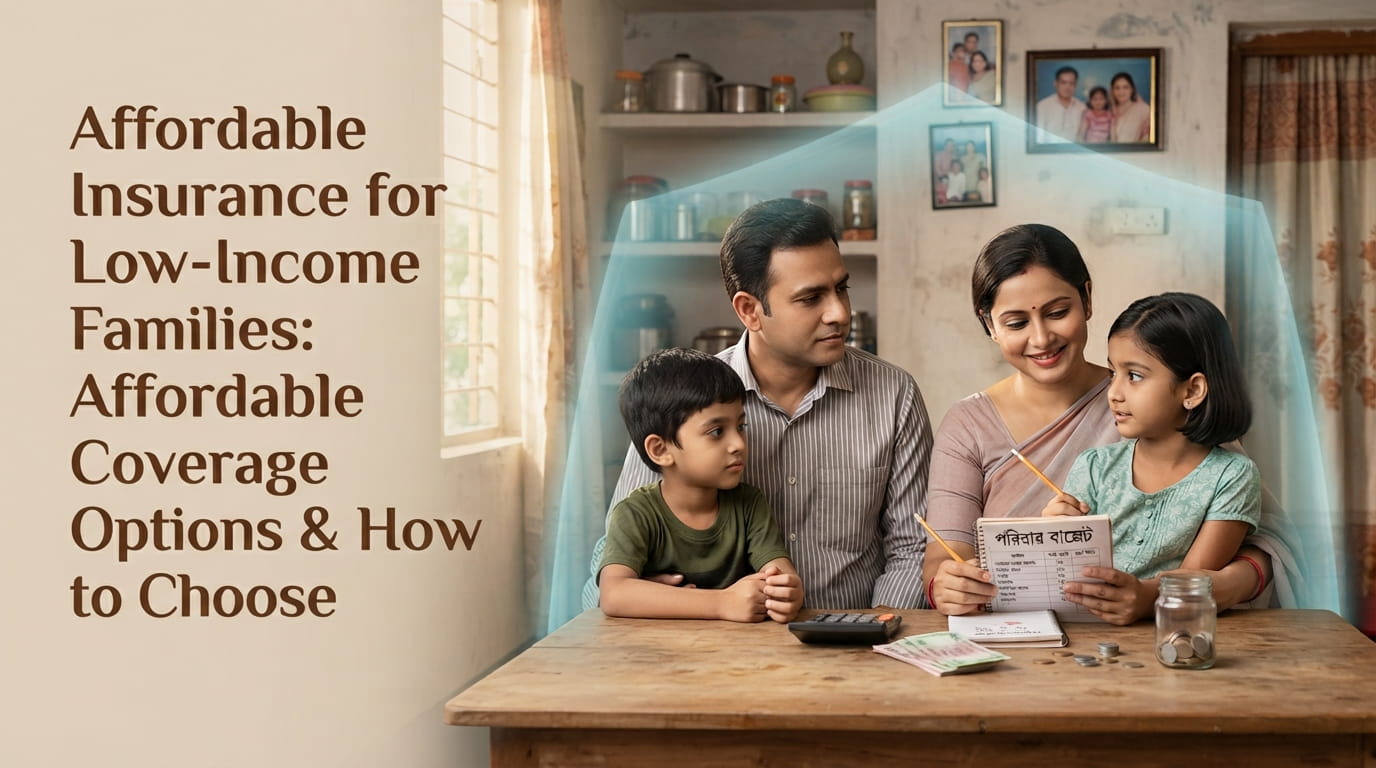
Affordable Insurance for Low-Income Families: Affordable Coverage Options & How to Choose
Imagine a family in Bangladesh with a monthly income of ৳30,000.
Every month, money goes toward food, rent, children's education, transport, medicine, utility bills, and other household needs. There may not be much left at the end of the month.
For such a family, thinking about life insurance can feel difficult. “Insurance তো extra expense—এটা কি আমাদের জন্য possible?”
But affordable life insurance is not necessarily about buying a large policy. It is about finding a level of financial protection that a family can realistically maintain over time.
If the main income earner dies unexpectedly, the family may suddenly lose the money that pays for everyday living. A suitable life insurance policy can help provide financial support according to the policy's terms.
So the goal should not be simply to find the cheapest insurance. The better goal is to find affordable insurance that provides useful protection without creating financial pressure.
🔷 What Is Affordable Insurance for Low-Income Families?
Affordable insurance for low-income families means life insurance that provides meaningful financial protection while keeping the premium or contribution manageable for the family's regular budget. The right policy should be sustainable—not simply the cheapest option available.
সহজভাবে বললে, আপনার income limited হলে এমন premium বেছে নেওয়া উচিত যেটা আপনি long term-এ comfortably continue করতে পারবেন।
A low-cost policy can become expensive in practice if the family cannot maintain payments. At the same time, a policy with a higher premium may not be suitable if it affects essential household expenses.
Therefore, affordability depends on:
🔸Monthly income
🔸Essential household expenses
🔸Number of dependents
🔸Existing loans or debts
🔸Financial goals
🔸Policy term
🔸Coverage amount
🔸Premium payment schedule
🔸Policy conditions and benefits
The Bangladesh Insurance Act defines insurance around contracts where a premium is received in exchange for specified benefits contingent on events covered by the contract. That means the actual policy document matters: consumers should understand exactly what the contract covers before purchasing.
🔷Why Do Low-Income Families Need Life Insurance?
Low-income families often have less room to absorb a major financial shock.
Consider a household where one person earns most of the income. If that person dies, the family may still have to pay:
🔸Food and household expenses
🔸Children's school or education costs
🔸Rent or housing expenses
🔸Utility bills
🔸Existing loans
🔸Transportation costs
🔸Medical and emergency expenses
🔸Other family responsibilities
For example, ধরুন a father earns ৳30,000 per month and supports a spouse, two children, and an elderly parent.
If his income suddenly disappears, the family does not lose only a salary. They lose the regular cash flow that supports several people.
Life insurance cannot replace every financial need. But an appropriate policy may provide financial support to eligible beneficiaries according to its terms.
That is why family financial protection can be important even when income is limited.
The key is to start with a realistic policy rather than stretching the household budget.
🔷 Types of Affordable Life Insurance Options in Bangladesh
There is no single “best” insurance policy for every low-income family. Different products are designed around different financial goals.
National Life Insurance PLC currently presents product categories including Child Insurance, Pension Policy, Savings Policy, DPS, Whole Life, Survival Benefit, Islami Takaful, FDR and Group Insurance. Its published product information also includes monthly savings and microinsurance-related products.
Here are some options families may explore.
🔷Whole Life Insurance
Whole life insurance is designed around long-term life protection, subject to the specific policy terms.
It may be relevant for someone who wants longer-term protection rather than insurance only for a short financial goal.
However, families should carefully compare:
🔸Premium requirements
🔸Coverage
🔸Policy duration
🔸Applicable benefits
🔸Conditions
🔸Exclusions
🔸Surrender or other applicable rules
Don't choose whole life insurance simply because the name sounds comprehensive. The actual policy document should determine whether it fits your family.
🔷 Savings-Oriented Life Insurance
Savings-oriented insurance can combine insurance protection with a structured savings objective, depending on the specific product.
For a family that finds it difficult to save regularly, a structured payment plan may create financial discipline.
National Life Insurance PLC lists Savings Policy and monthly savings-related insurance products among its offerings.
তবে একটা important point হলো—insurance আর ordinary savings account এক জিনিস নয়।
Before purchasing, understand both the protection element and the savings or maturity conditions.
🔷 Child Insurance
Parents often want to build a financial backup for their children's education and future.
Child-focused insurance can be relevant when the primary goal is planning for a child's future.
National Life Insurance PLC's current Child Insurance category includes Child Protection Policy, Children Education Security Plan and other child-focused products.
For parents with a limited income, the important question is not simply “Is child insurance available?”
Instead ask:
“Can I maintain the required payment while still meeting my family's current needs?”
🔷 Pension Insurance
Pension-oriented insurance may be useful for people who want to prepare for future retirement needs.
This can be particularly important for self-employed workers or people without a strong employer-sponsored retirement arrangement.
National Life Insurance PLC lists Pension Policy among its product categories and its annual report includes pension-related insurance products.
Before choosing one, check when benefits become payable, contribution requirements, applicable benefits, and policy conditions.
🔷 Microinsurance / Small Savings Insurance
For lower-income households, smaller insurance solutions can be especially relevant because affordability is often the first concern.
National Life Insurance PLC's published product information includes Monthly Small Savings Insurance and Monthly Deposit Micro Insurance-MDMI.
These products should not automatically be assumed to be suitable for everyone. Compare the actual premium, protection, duration, benefits and conditions before making a decision.
🔷 Group Insurance
Some workers may receive insurance through an employer or organization.
National Life Insurance PLC lists Group Term Insurance, Group Endowment Insurance, Group Economy Insurance and Group Anticipated Insurance among its group offerings.
Group insurance can be useful because employees may obtain protection through an organizational arrangement. However, always understand who is covered, what benefits apply, how long coverage lasts, and what happens if employment changes.
🔷 Which Insurance Option May Match Your Family's Needs?
There is no single life insurance option that is right for every family. The most suitable choice depends on your family's financial goals, income, responsibilities, protection needs, and long-term plans.
🔷 What Type of Insurance Is Best for Long-Term Family Protection?
Families looking for long-term financial protection may consider Whole Life Insurance. It is designed to provide long-term life coverage, subject to the policy's terms, conditions, and benefits.
🔷 Which Insurance Is Suitable for a Child's Future or Education?
If your goal is to prepare financially for a child's education or future needs, Child Insurance may be an option to explore. It can help parents create a structured financial plan for important future milestones.
🔷 Which Insurance Is Suitable for Savings and Protection?
Families that want to combine long-term savings with life protection may consider savings-oriented insurance products. These policies can provide a structured way to save while also offering insurance protection, depending on the specific product and policy terms.
🔷 Which Insurance Is Suitable for Retirement Planning?
For people preparing for their post-retirement financial needs, a Pension Policy may be worth considering. It can help create a planned financial arrangement for retirement, subject to the policy's features and conditions.
🔷 Is There Insurance for Families With a Smaller Budget?
Families that prefer smaller and regular contributions may explore monthly small savings or microinsurance-related products, where available. These options may be useful for people who want to build financial protection gradually without committing to a large payment at once.
🔷 Can Employees Get Life Insurance Through Their Employer?
Yes. Some employees may receive protection through Group Insurance provided by their employer. Group insurance can offer coverage to eligible employees under an employer-sponsored plan, with benefits and eligibility determined by the specific group policy.
🔷 Is There Shariah-Oriented Insurance in Bangladesh?
People who prefer Shariah-oriented financial planning may explore applicable Islami Takaful products. The suitability of a Takaful product depends on its structure, terms, conditions, eligibility requirements, and the individual's financial objectives.
🔷 How Should a Family Choose the Right Insurance?
Start by identifying your primary financial goal. Ask yourself:
🔸Do you mainly need long-term family protection?
🔸Are you planning for your child's education or future?
🔸Do you want structured savings with protection?
🔸Are you preparing for retirement?
🔸Do you prefer smaller regular contributions?
🔸Does your employer already provide group insurance?
🔸Do you prefer a Shariah-oriented financial solution?
Once you understand your main goal, compare the relevant insurance options based on coverage, premium affordability, policy duration, benefits, exclusions, maturity or survival benefits, surrender terms, and other applicable conditions.
Important: Insurance Suitability Depends on Your Situation
The options discussed above are general insurance directions, not recommendations for a specific policy. The right choice depends on your financial situation, family responsibilities, future goals, affordability, and the actual terms of the policy.
Before purchasing insurance, carefully review the policy document, benefits, exclusions, premium requirements, claim conditions, and other applicable terms. If needed, speak with a qualified insurance professional to understand which option may fit your circumstances.
🔷 How Much Life Insurance Can a Low-Income Family Afford?
There is no single official premium amount that works for every family.
A family earning ৳25,000 per month and another earning ৳50,000 may have completely different responsibilities.
Instead of asking, “What is the cheapest policy?”, start with these questions:
🔸 How much money comes into the household each month?
🔸How much is required for essential expenses?
🔸How many people depend on the income?
🔸Does the family have existing debt?
Is there an emergency fund?
🔸What financial goals are important?
🔸Can the premium be paid consistently?
🔷 A Simple Example
Suppose a household earns ৳30,000 per month.
Its monthly expenses might include:
🔸Food and household needs: ৳15,000
🔸Rent: ৳6,000
🔸Education: ৳3,000
🔸Transport and utilities: ৳3,000
🔸Other essential costs: ৳2,000
That leaves approximately ৳1,000 before considering unexpected expenses.
For this family, buying a policy with a payment that regularly creates financial stress may not be sensible.
Instead, the family could explore whether a smaller and sustainable insurance option is available.
The exact premium should be calculated from the actual product, age, policy term, coverage and other applicable factors—not guessed from a general percentage.
🔷 Affordable Insurance vs Cheap Insurance: What's the Difference?
Affordable insurance is not always the same as cheap insurance. Cheap insurance mainly focuses on having the lowest price, while affordable insurance focuses on getting suitable protection at a premium that the policyholder can realistically maintain over time.
🔷What Is Cheap Insurance?
Cheap insurance generally means a policy with a lower premium or lower upfront cost. While paying less may seem attractive, a cheaper policy may provide limited coverage, fewer benefits, or protection that does not fully match the family's financial needs.
🔷 What Is Affordable Insurance?
Affordable insurance means a policy that provides appropriate protection at a premium the customer can comfortably and consistently afford. The focus is not only on price but also on coverage, benefits, sustainability, and long-term suitability.
🔷 What Is the Difference Between Cheap and Affordable Insurance?
The key difference is the decision-making approach. Cheap insurance focuses primarily on price, while affordable insurance considers the overall value of the protection.
A cheap policy may have a lower premium but limited coverage. An affordable policy may cost slightly more but provide protection that better matches the family's responsibilities while remaining financially sustainable.
🔷 Is the Cheapest Insurance Policy Always the Most Affordable?
No. The cheapest policy is not automatically the most affordable policy.
For example, suppose Policy A has a lower premium but provides limited protection. Policy B costs slightly more but offers coverage that better matches the family's financial responsibilities and can still be comfortably maintained.
For that family, Policy B may offer better overall value because the goal is not simply to pay the lowest premium—it is to maintain suitable financial protection without creating unnecessary financial pressure.
🔷 What Should You Consider When Choosing Affordable Insurance?
Instead of looking only at the premium, consider:
🔸 Coverage: Does the policy provide the protection your family actually needs?
🔸Premium affordability: Can you comfortably maintain the payments over the policy term?
🔸 Benefits: What benefits are included under the policy?
🔸 Exclusions: What situations or conditions are not covered?
🔸 Policy duration: Does the policy period match your financial goals?
🔸 Long-term suitability: Can the policy continue to meet your needs as your financial responsibilities change?
🔸 Overall value: Does the protection justify the premium you will pay?
🔷 Affordable vs Cheap Insurance: Which One Should You Choose?
The better approach is to look for affordable coverage that matches your actual financial needs, rather than simply choosing the policy with the lowest price.
Remember: Affordable means sustainable. Cheap simply means low-priced. A suitable insurance decision should balance premium, protection, benefits, affordability, and long-term financial needs.
🔷 How Much Life Insurance Coverage Does a Low-Income Family Need?
One of the biggest questions families ask is:
“আমার পরিবারের জন্য কত life insurance coverage যথেষ্ট?”
There is no single coverage amount that works for every family. The right level depends on income, dependents, household expenses, debt, children's future needs and existing savings.
A simple way to think about your family's protection need is to consider:
Current financial responsibilities + future family needs − existing financial resources = approximate protection gap
For example, a family with one main income earner, two children and outstanding debt may have a different protection need from a household with multiple earners and fewer dependents.
Before choosing a policy, consider:
🔸 Who depends on the main income?
🔸 How much does the family need for essential monthly expenses?
🔸 Are there outstanding loans or debts?
🔸 How much emergency savings already exist?
🔸 What future costs are important, such as children's education?
🔸 How much coverage can be maintained within the available budget?
This is only a planning framework—not a guaranteed insurance calculation.
The objective is not to buy the largest policy. It is to reduce the family's financial protection gap with a sustainable level of coverage.
🔷 Can Life Insurance and Emergency Savings Work Together?
Yes. Life insurance and emergency savings can serve different financial purposes, so families may consider them as complementary parts of a broader financial plan.
🔷 Emergency savings are mainly for:
🔸Unexpected household expenses
🔸Temporary income disruption
🔸Urgent repairs
🔸Short-term financial needs
🔷 Life insurance is designed for:
🔸Financial protection against specified insured events
🔸Supporting eligible beneficiaries according to policy terms
🔸Long-term financial protection or other stated policy objectives
For example, suppose a family has limited extra income each month.
Using every available amount for insurance may leave the family without accessible cash for emergencies. On the other hand, keeping all savings in cash may not address the financial risk associated with the death of a main income earner.
So, where financially possible, families can think in two layers:
Emergency savings → short-term financial resilience
Life insurance → protection against specified long-term financial risks
The exact balance depends on the family's income, responsibilities and financial situation.
🔷 What Should You Ask Before Buying Life Insurance?
Many insurance problems can be avoided simply by asking the right questions before signing up.
Before purchasing, ask the insurer or authorized representative:
🔷 About the Premium
🔸How much is the premium?
🔸How often must I pay it?
🔸What payment methods are available?
🔸What happens if I miss a payment?
🔷 About the Protection
🔸What exactly does this policy cover?
🔸How much is the applicable benefit?
🔸When can the benefit become payable?
🔸What exclusions or special conditions apply?
🔷 About the Policy
🔷How long does the policy continue?
🔷What happens if I discontinue it?
🔷Are there surrender or other applicable conditions?
🔷Can the policy be revived after discontinuation, and under what rules?
🔷 About the Family
🔸Who can be nominated?
🔸Can nominee information be changed?
🔸What documents should my family keep?
🔷 About Future Benefits
🔸Which benefits are guaranteed under the policy?
🔸Which benefits depend on conditions, bonuses or other factors?
🔸Where can I obtain official service or claim information later?
If an important answer is unclear, do not rush to purchase. Ask for clarification and review the official policy document first.
🔷 The Affordable Insurance Decision Test: 5 Questions to Ask Yourself
Before buying affordable life insurance, take five minutes and answer these questions honestly.
1. What am I trying to protect?
Is your main concern family income, children's education, savings, retirement or another financial goal?
2. Who depends on my income?
Think about your spouse, children, parents or other family members who may depend on your financial support.
3. What can I comfortably afford?
Look at your actual income after food, rent, education, utilities, transportation, healthcare and other essential expenses.
4. Do I understand the policy?
You should understand the premium, coverage, benefits, exclusions, policy term and payment rules before committing.
5. Can I maintain the policy during a difficult year?
This is perhaps the most important question.
A policy that fits your budget today but becomes impossible to maintain later may not be the right choice.
A simple decision rule:
Affordable = Manageable Premium + Useful Protection + Clear Terms + Long-Term Sustainability
If a policy passes all four areas, it deserves closer consideration.
If it fails one or more, take another look before making a commitment.
The strongest insurance decision is not the one that looks cheapest today. It is the one that continues to make financial sense for your family over time.
🔷 How to Choose the Right Life Insurance for Your Family
Step 1: Understand Your Family's Financial Risk
Identify who earns the income and who depends on it.
If one person supports several family members, income protection may deserve greater attention.
Step 2: Calculate a Comfortable Premium Budget
Look at your real monthly budget.
Don't sacrifice food, rent, education, medicine or essential expenses just to buy a larger policy.
Step 3: Decide the Required Protection
Think about what your family would need if the primary income earner were no longer available.
Consider household expenses, education, debts and future goals.
Step 4: Compare Policy Benefits
Do not compare only premiums.
Check:
🔸Coverage
🔸Policy duration
🔸Maturity-related benefits
🔸Payment schedule
🔸Applicable bonuses, if any
🔸Conditions
🔸Exclusions
🔸Other charges or rules
Step 5: Understand Exclusions and Conditions
Every insurance policy has terms.
Read the official policy document and ask questions about situations that may affect eligibility for benefits.
Step 6: Check Payment Frequency and Deadlines
Missing payments can affect a policy according to its terms.
Before purchasing, make sure the payment schedule fits your income pattern.
Step 7: Choose and Update the Nominee
The nominee information is important because it identifies the person designated to receive applicable benefits, subject to the policy and applicable rules.
Keep nominee details accurate and update them when necessary.
Step 8: Verify Policy Information
Keep your policy number, receipts, documents and insurer contact information safely.
Bangladesh's IDRA also operates a policyholder portal where customers can search policy information using insurer, policy number and other required information.
Step 9: Read Official Policy Documents Before Purchasing
This is one of the most important steps.
Do not depend only on an advertisement, social-media post or verbal explanation.
Ask for the official product information and understand the exact terms before making a commitment.
🔷Common Mistakes Low-Income Families Should Avoid
1. Choosing Only the Lowest Premium
A low premium may come with lower or different protection. Compare value, not just price.
2. Buying More Coverage Than You Can Maintain
A large policy is not useful if the premium becomes difficult to pay.
3. Not Reading Exclusions
Never assume every situation is covered.
4. Missing Premium Deadlines
Understand what happens if you miss a payment and what options are available under the policy.
5. Trusting Unrealistic Return Promises
Avoid decisions based on verbal promises such as “guaranteed high returns” unless those terms are clearly stated in official documents.
6. Ignoring the Nominee
Incorrect or outdated nominee information can create unnecessary complications.
7. Treating Insurance Like a Normal Savings Account
Insurance can have a protection component that ordinary savings products do not provide. Understand the difference before purchasing.
8. Not Comparing Products
Different families have different goals. A child-focused product may not be appropriate for someone whose main goal is retirement planning.
🔷Why Consider National Life Insurance PLC?
National Life Insurance PLC offers a broad range of life insurance-related products and categories for different financial objectives.
Its official product information includes Child Insurance, Pension Policy, Savings Policy, DPS, Whole Life, Survival Benefit, Islami Takaful, FDR and Group Insurance. Its annual report also lists products such as Monthly Savings Insurance, Monthly Small Savings Insurance, Monthly Deposit Micro Insurance-MDMI, Family Savings & Income Insurance, pension products and group insurance.
This range can be useful because a family does not always have only one financial goal.
For example:
🔸A parent may explore Child Insurance for children's future planning.
🔸A working person may consider Whole Life for long-term protection.
🔸Someone preparing for retirement may explore a Pension Policy.
🔸A family looking for structured savings may investigate Savings Policy or DPS.
🔸A lower-income household may want to explore Monthly Small Savings Insurance or Monthly Deposit Micro Insurance-MDMI.
🔸An employee may have access to Group Insurance through an organization.
🔸A customer seeking a Shariah-oriented approach may explore applicable Islami Takaful products.
The important point is that National Life Insurance PLC's product range should be viewed as a set of options—not as a reason to choose a policy without comparison.
Your age, income, family responsibilities, policy term, premium, financial goals and the exact policy conditions should all be considered.
🔷Is Life Insurance Worth It for a Low-Income Family?
For many families, the value of life insurance comes from financial protection—not simply from receiving money in the future.
If a family depends heavily on one income earner, even a manageable level of protection may be worth considering.
But insurance should not create new financial stress.
The right question is not “Can I afford a big insurance policy?”
The better question is:
“What level of protection can my family afford to maintain consistently?”
That small change in thinking can make insurance planning much more practical.
🔷Final Thoughts
Affordable life insurance for low-income families is possible when the decision starts with the family's real financial situation.
You do not need to choose a policy simply because someone calls it “cheap” or “best.”
Instead:
🔸Understand your family's risks.
🔸Set a realistic budget.
🔸Compare suitable insurance options.
🔸Read the official policy terms.
🔸Check benefits and exclusions.
🔸Keep nominee information updated.
🔸Choose a payment level you can maintain.
For Bangladeshi families, the goal should be affordable financial protection—not financial pressure.
If you are exploring life insurance, take time to understand your needs first and then compare suitable products from National Life Insurance PLC based on your budget, family responsibilities and long-term goals.
Frequently Asked Questions :
1. What is the cheapest life insurance for low-income families in Bangladesh?
There is no single policy that can be called the cheapest for every family. Premiums can depend on factors such as age, policy type, term, coverage and applicable conditions. Low-income families should compare the actual premium with the protection provided and choose a policy they can maintain consistently.
2. Can low-income people buy life insurance in Bangladesh?
Yes, low-income people may be able to explore life insurance and small-savings or microinsurance-related products, depending on the product's eligibility and terms. National Life Insurance PLC publishes Monthly Small Savings Insurance and Monthly Deposit Micro Insurance-MDMI among its product offerings.
3. How much does life insurance cost in Bangladesh?
There is no single price for life insurance in Bangladesh. The cost can vary according to the product, age, coverage, policy term, payment structure and other applicable factors. The safest approach is to request the current premium for the specific policy you are considering.
4. Is life insurance worth it for a low-income family?
It can be worth considering when family members depend on one person's income. The purpose is to create financial protection against an unexpected loss of income. However, the policy should remain affordable. A premium that regularly damages the household budget may not be sustainable.
5. What is the best insurance for a family in Bangladesh?
There is no universal “best” insurance policy. A family with young children may prioritize child-focused protection, while another family may prioritize whole-life protection, savings or retirement planning. The right choice depends on income, dependents, financial goals, coverage needs and the policy's actual terms.
6. Can I buy life insurance with a small monthly income?
A person with a small monthly income can explore insurance products designed around smaller or regular contributions, subject to eligibility and policy terms. National Life Insurance PLC publishes monthly savings and microinsurance-related products. The key is choosing a payment level that remains manageable over the long term.
7. What is microinsurance in Bangladesh?
Microinsurance generally refers to insurance solutions designed around relatively accessible levels of protection and contributions for people who may have limited financial capacity. The exact structure varies by product. Consumers should check the insurer's official documents for premium, coverage, eligibility, exclusions and benefit conditions.
8. How can I choose affordable life insurance?
Start by reviewing your monthly income, essential expenses, dependents, debt and financial goals. Then compare suitable policies based on premium, coverage, term, benefits and conditions. Do not choose only because the premium is low. A sustainable policy is generally more useful than one you cannot maintain.
9. How much life insurance coverage does a family need?
The amount depends on the family's financial responsibilities. Consider regular household expenses, children's education, debt, number of dependents and future goals. There is no universal coverage amount that fits every family. A financial adviser or insurer can help you evaluate the appropriate level based on the actual policy options.
10. What factors affect life insurance premiums?
Premiums may vary based on factors such as the insured person's age, policy type, coverage amount, policy term, payment frequency and other underwriting or product-specific conditions. Because each insurer and product can have different rules, consumers should request the current quotation for the specific policy.
11. Can parents buy insurance for their children?
Parents may explore child-focused insurance products where the applicable product permits it. National Life Insurance PLC lists Child Protection Policy and Children Education Security Plan among its child insurance offerings. Parents should review eligibility, benefits, premium requirements and policy conditions before purchasing.
12. What is whole life insurance?
Whole life insurance is generally designed to provide long-term life protection, subject to the specific policy terms. It can be different from short-term or goal-specific insurance. Before purchasing, check the premium structure, applicable benefits, duration, exclusions and other conditions in the official policy documents.
13. What is child insurance in Bangladesh?
Child insurance refers to insurance products designed around financial protection or future planning for children, depending on the product. National Life Insurance PLC lists several child-focused products, including Child Protection Policy and Children Education Security Plan. The actual benefits and conditions should be checked in the relevant policy document.
14. What is pension insurance?
Pension insurance is designed around long-term retirement planning, subject to the product's terms. It may help people prepare financially for a period when employment income decreases or stops. National Life Insurance PLC lists Pension Policy among its product categories. Always check contribution requirements, benefit timing and conditions before purchasing.
15. What is group life insurance?
Group life insurance provides insurance coverage to a defined group, such as employees of an organization, under a group arrangement. National Life Insurance PLC offers several group insurance products, including Group Term Insurance and Group Economy Insurance. The exact coverage and conditions depend on the applicable group policy.
16. What happens if I miss a life insurance premium?
The consequences depend on the specific policy and its terms. A missed payment may affect the policy's status, benefits or continuation. Before buying, ask the insurer what happens after a missed premium, whether there is a grace period, and what steps are required to keep the policy active.
17. How do I choose a life insurance nominee?
Choose a nominee who should receive applicable policy benefits according to the policy and applicable rules. Make sure the nominee's information is accurate. Review it when major family circumstances change. Keep your policy documents and nominee information safely recorded.
18. What should I check before buying life insurance?
Check the premium, coverage, policy term, payment frequency, applicable benefits, exclusions, eligibility requirements, nominee information and rules for missed payments. Most importantly, read the official policy document. Do not rely only on advertisements or verbal explanations.
19. Is life insurance better than keeping money in savings?
Life insurance and ordinary savings serve different purposes. Savings primarily focus on accumulating money, while life insurance can provide financial protection according to the policy terms. Some insurance products also have savings or maturity features. Families should understand the difference before deciding which financial tool fits their goal.
20. How can families protect their income with life insurance?
A family can consider life insurance as one part of a broader financial protection plan. If an income earner dies and the policy covers the event, eligible benefits may provide financial support according to the policy. Families should choose coverage based on dependents, expenses, debts and long-term needs.
21. Can working-class families afford life insurance?
Working-class families may be able to explore affordable or smaller-payment insurance options, depending on eligibility and available products. National Life Insurance PLC lists monthly savings and microinsurance-related products. Affordability should always be judged against the family's real monthly budget and ability to continue payments.
22. What documents are needed to buy life insurance?
The required documents can vary by insurer and policy. Depending on the product, applicants may need identification, personal information, nominee information and other documents requested during the application process. Always confirm the current document requirements directly with the insurer before submitting an application.
23. How can I compare life insurance policies in Bangladesh?
Create a simple comparison covering premium, coverage, term, payment frequency, benefits, exclusions, nominee rules and missed-payment conditions. Then read the official documents. Comparing these factors gives a better picture than comparing premiums alone.
24. What are the benefits of life insurance for families?
Depending on the policy, life insurance can provide financial protection against specified insured events and may also include savings, maturity or other benefits. The exact benefits differ between products. Families should review the specific policy document rather than assuming every life insurance policy provides the same benefits.
25. How can I find a suitable life insurance policy in Bangladesh?
Start by identifying your main goal—family protection, children's future, savings, retirement or another financial objective. Then compare relevant products based on affordability, benefits, coverage and conditions. National Life Insurance PLC's official website provides information about multiple product categories that families can explore.
← Back to Insights
NLI Archive / 2026
Trending Analysis
Affordable Insurance for Low-Income Families: Affordable Coverage Options & How to Choose
N
NLI Editorial
© National Life Insurance Co. Ltd.
Share:
FB
LN